Aboriginal Australian Art
40000 BCE–presentThe oldest continuous art tradition on Earth. Contemporary Aboriginal painting carries ancestral knowledge — the Dreaming, Country, and the law of the land — through layered visual systems built on earth pigments.
Traditional: earth pigments (ochres, kaolin, charcoal) on rock, bark, and body. Contemporary: acrylic on canvas using the same color language. The palette is determined by the desert landscape itself.
Western Desert Movement
b. 1971Australian (Aboriginal)
Beginning at Papunya in 1971, Aboriginal artists translated sacred ground designs into acrylic on canvas. The dot-painting technique was developed partly to conceal sacred elements from uninitiated viewers.
The dot technique applies thousands of small acrylic dots in earth tones — ochre, white, red, black — creating optical patterns that shimmer like the desert landscape.
Desert ochre red
Red ochre (hematite) — the most sacred pigment in Aboriginal tradition, used for ceremony and body decoration. In contemporary painting, cadmium red + raw sienna approximates it.
Material: Red ochre (traditional) / cadmium red + raw sienna (contemporary acrylic)
RGB(160, 64, 32)
Desert ochre yellow
Yellow ochre — sourced from specific sacred sites. Each ochre deposit has a slightly different hue. In acrylic, yellow ochre + cadmium yellow.
Material: Yellow ochre (traditional) / yellow ochre + cadmium yellow (acrylic)
RGB(200, 152, 48)
Kaolin white
White pipeclay (kaolin) — used in ceremony and painting. The warm white of desert clay, not the cool white of European lead or zinc.
Material: Kaolin pipeclay (traditional) / titanium white + raw umber (acrylic)
RGB(240, 224, 208)
Charcoal black
Charcoal or manganese — the darkest mark available from the land. In the dot technique, black dots create depth and contour.
Material: Charcoal/manganese (traditional) / mars black (acrylic)
RGB(27, 24, 16)
Earth brown
Raw umber — the color of the desert surface. This is the base tone of the Australian interior, the ground from which all other colors emerge.
Material: Brown ochre (traditional) / raw umber (acrylic)
RGB(106, 74, 40)
Water blue
A blue rarely used in traditional work but appearing in contemporary paintings to represent water — the most precious element in desert cosmology.
Material: Cerulean blue acrylic (contemporary addition)
RGB(58, 120, 160)
Pigments: Cadmium red · Ochre · Sienna · Cadmium yellow · Umber · Titanium white · Cerulean blue
Related Materials
If this palette inspired you, here’s what to paint with.
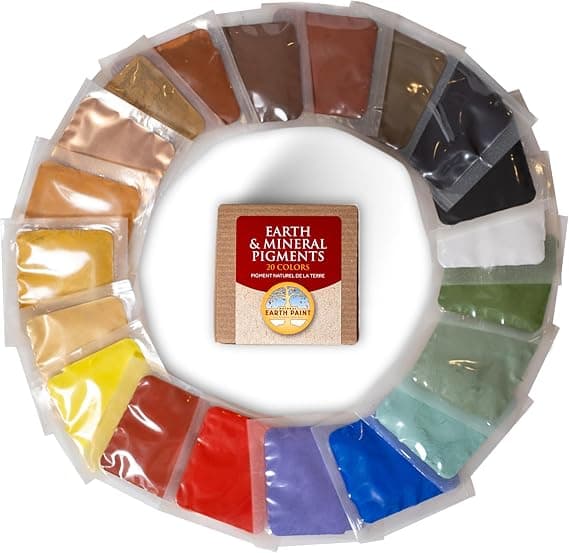 Natural Earth Paint Pigment Sample Pack, 20 Mineral PigmentsView on Amazon
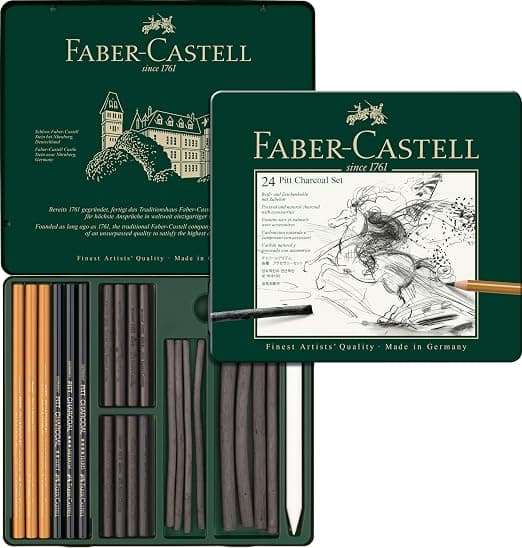 Faber-Castell Pitt Charcoal Set, 24 PieceView on Amazon
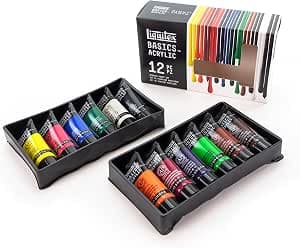 Liquitex BASICS Acrylic Paint Set, 12 TubesView on Amazon
As an Amazon Associate, Pigmentoria earns from qualifying purchases. This page may contain affiliate links.