Pre-Columbian Art
200 BCE–1500 CEThe color traditions of Mesoamerican and South American civilizations — murals, ceramics, and textiles using pigments unknown to the Old World.
Maya blue (a synthetic pigment of indigo + palygorskite clay), cochineal red from insects, and mineral pigments on lime plaster and ceramic. These pigments are extraordinarily durable — Maya blue survives centuries in tropical conditions.
Bonampak Muralists
580–800Maya
The anonymous Maya painters of the Bonampak murals — the most complete surviving cycle of pre-Columbian painting. Three rooms showing battle, triumph, and ritual.
The Bonampak murals use Maya blue — an artificial pigment made by heating indigo with palygorskite clay. It is one of the most chemically stable pigments ever created by any civilization.
Maya blue
Maya blue — indigo molecules trapped in palygorskite clay crystal lattice. This chemical bond makes it nearly indestructible. Surviving murals still glow turquoise after 1,200 years.
Material: Indigo + palygorskite clay (Maya blue synthesis)
RGB(56, 128, 160)
Ritual blood red
Hematite (iron oxide) red — the color of sacrifice, blood, and the east (sunrise). One of the most symbolically charged colors in Maya cosmology.
Material: Hematite (iron oxide) on lime plaster
RGB(144, 24, 32)
Jade green
Malachite or green earth — the color of jade, the most precious material in Mesoamerica. Green represents maize, life, and royal authority.
Material: Malachite or green earth on lime plaster
RGB(42, 104, 72)
Lime plaster white
Calcium carbonate lime plaster — both the surface and the white pigment. The warm white of limestone, the building material of the Maya world.
Material: Calcium carbonate lime plaster (sascab)
RGB(239, 224, 208)
Carbon black
Charcoal or soot black for outlines and hair. The darkest tone, used to define figures against the blue and red backgrounds.
Material: Charcoal or soot on lime plaster
RGB(20, 18, 16)
Yellow earth
Yellow ochre or limonite — the color of the south in Maya cosmology. Used for skin tones, background, and to indicate direction.
Material: Yellow ochre (limonite) on lime plaster
RGB(202, 160, 64)
Pigments: Lime white · Ochre · Green earth · Malachite · Lamp black
Nazca Ceramic Painters
-100–600Nazca (Peru)
The Nazca civilization of coastal Peru produced the most colorful ceramics in the pre-Columbian world — up to 15 different slip colors on a single vessel.
Nazca polychrome uses mineral slip pigments (finely ground minerals in clay suspension) applied before firing. The range of colors achievable rivals any ceramic tradition in world history.
Slip red
Iron-rich clay slip fired in oxidizing atmosphere. The reds of Nazca ceramics range from orange to deep crimson depending on firing conditions.
Material: Iron-rich clay slip, oxidizing fire
RGB(168, 48, 32)
Slip cream
Kaolin-rich white clay slip — the lightest tone in Nazca pottery. Used for backgrounds and to outline figures.
Material: Kaolin-rich white clay slip
RGB(224, 208, 176)
Slip black
Manganese dioxide slip — creates a deep black when fired. Used for outlines and the bold graphic patterns that define Nazca style.
Material: Manganese dioxide clay slip, reduction fired
RGB(26, 24, 16)
Slip orange
Iron oxide slip at moderate concentration — between the red and cream tones. Used for skin, desert, and transitional areas.
Material: Moderate iron oxide clay slip
RGB(200, 112, 40)
Slip grey
Reduced iron slip — the same material as the red but fired in reducing (oxygen-poor) atmosphere, turning it grey.
Material: Iron clay slip, reducing fire
RGB(122, 120, 112)
Slip violet
Manganese + iron mixed slip — one of the rarest Nazca colors, a true violet achievable only with precise firing control.
Material: Manganese + iron mixed clay slip, controlled firing
RGB(90, 48, 72)
Related Materials
If this palette inspired you, here’s what to paint with.
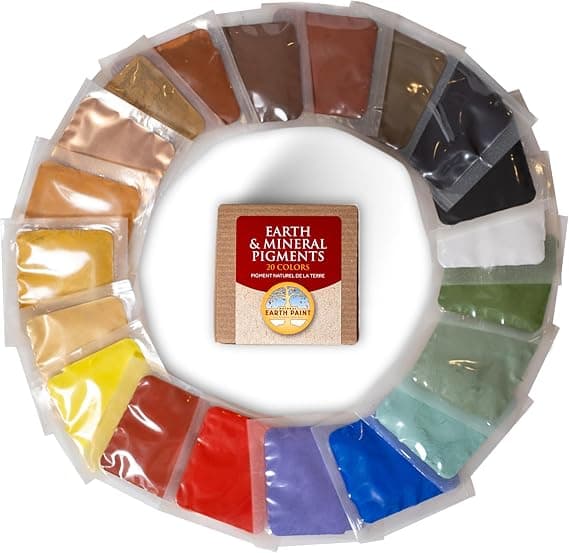 Natural Earth Paint Pigment Sample Pack, 20 Mineral PigmentsView on Amazon
 Winsor & Newton Designers Gouache, Set of 6 TubesView on Amazon
 Moleskine Art Plus Watercolor Album, LargeView on Amazon
As an Amazon Associate, Pigmentoria earns from qualifying purchases. This page may contain affiliate links.