Ukiyo-e (Floating World)
1680–1880Japanese woodblock prints — the 'pictures of the floating world.' A mass-produced art form with some of the most sophisticated color printing in pre-modern history.
Woodblock printing with water-based pigments on handmade washi paper. Each color requires a separate carved block, printed in sequence. Registration marks ensure perfect alignment.
Katsushika Hokusai
1760–1849Japanese
The old man mad about painting. Hokusai's Great Wave and 36 Views of Mount Fuji are among the most recognized images in world art.
Hokusai exploited the newly imported Prussian blue (bero-ai) to revolutionary effect. Before this pigment reached Japan around 1830, Japanese prints relied on vegetable blues that faded rapidly.
Great Wave blue
Prussian blue (bero-ai) — the imported synthetic pigment that transformed Japanese prints. Hokusai was among the first to use it as a dominant color.
Material: Prussian blue (bero-ai) on washi paper
RGB(27, 72, 120)
Reference: The Great Wave off Kanagawa (c. 1831)
Fuji snow white
The unprinted washi paper — Hokusai used the paper's warm white as the snow on Mount Fuji. The paper is the lightest 'color.'
Material: Unprinted kozo washi paper
RGB(234, 228, 216)
Sky gradation
Prussian blue graduated from dark to pale — the bokashi technique of blending ink on the woodblock before printing creates atmospheric gradients.
Material: Prussian blue, bokashi gradient technique
RGB(104, 152, 184)
Skin pink pale
Safflower red (beni) diluted to pale pink for skin. So pale it's almost just warm paper — a whisper of color.
Material: Safflower red (beni), heavily diluted
RGB(232, 200, 184)
Key block black
Sumi ink printed from the key block — the black outline that defines every form. Always printed first, all colors register to this outline.
Material: Sumi ink (pine soot + nikawa glue) on cherry woodblock
RGB(24, 24, 24)
Sunset red
Red lead (tan) or vermilion for the famous Red Fuji print. A warm, slightly orange red that captures the volcanic mountain at dawn.
Material: Red lead (tan) or vermilion on washi
RGB(202, 64, 32)
Reference: Fine Wind, Clear Morning (c. 1831)
Pigments: Prussian blue · Lamp black · Vermilion · Red lead
Utagawa Hiroshige
1797–1858Japanese
The master of rain, snow, and atmosphere. Hiroshige's landscape prints capture weather and time of day with a subtlety that influenced the Impressionists.
Hiroshige's genius is in the bokashi — graduated color printing. His rain, mist, and twilight effects use multiple passes of diluted pigment to create atmospheric depth.
Rain grey
Diluted sumi ink printed in fine diagonal lines over a bokashi grey wash — Hiroshige's signature rain effect. Each line is a separate impression.
Material: Sumi ink, fine-line rain printing over grey wash
RGB(106, 112, 120)
Twilight blue
Prussian blue in deep bokashi gradation — from near-black at the horizon to pale blue overhead. Hiroshige's twilight is the most atmospheric in ukiyo-e.
Material: Prussian blue, deep bokashi gradation
RGB(42, 72, 104)
Plum blossom red
Safflower red (beni) at medium concentration — the specific pink-red of plum blossoms, a key seasonal reference.
Material: Safflower red (beni), medium concentration
RGB(184, 48, 64)
Snow white (paper)
Unprinted paper as snow — Hiroshige's snow scenes use the paper itself, sometimes with embossing (karazuri) to create texture.
Material: Unprinted washi with karazuri embossing
RGB(234, 226, 216)
Leaf green
A mix of Prussian blue + gamboge yellow (aigami) for foliage. The specific green shifts with seasons — spring bright, summer deep, autumn golden.
Material: Prussian blue + gamboge (aigami) on washi
RGB(58, 120, 64)
Bridge brown
Persimmon tannin (kakishibu) — a traditional Japanese brown for woodwork and bridges. Warm, reddish, and historically accurate.
Material: Persimmon tannin (kakishibu) on washi
RGB(107, 74, 40)
Pigments: Prussian blue
Related Materials
If this palette inspired you, here’s what to paint with.
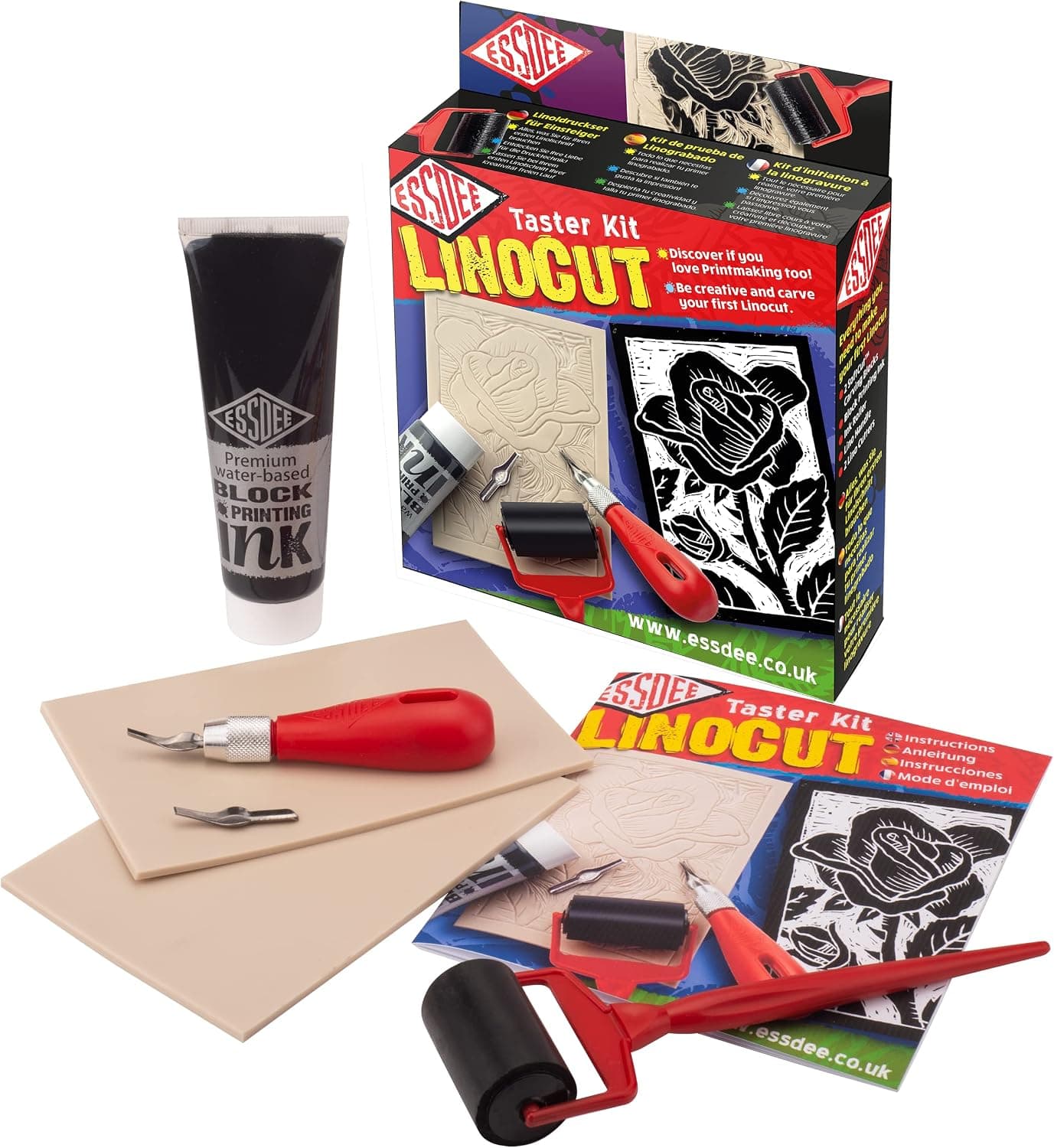 Essdee Linocut Taster KitView on Amazon
 Winsor & Newton Calligraphy Ink, Black, 30mlView on Amazon
 Winsor & Newton Designers Gouache, Set of 6 TubesView on Amazon
As an Amazon Associate, Pigmentoria earns from qualifying purchases. This page may contain affiliate links.