Jan van Eyck
1390–1441Flemish · Northern Renaissance 1420–1580
For four hundred years he was credited with inventing oil painting. He did not — but what he did with it was so far beyond anyone else that the legend is an understandable mistake.
Formation
Documented from 1422 as court painter to John of Bavaria and then to Philip the Good of Burgundy, a position that made him a salaried official rather than a guild craftsman, and sent him on diplomatic missions to Portugal and Spain. That status shows in the work: he signed and dated his pictures, unusual at the time, and his motto — als ich can, "as best I can" — appears on several frames. He worked in Bruges from 1429 until his death.
Technique
Oil was already in use before him; what van Eyck refined was a medium and a layering system that exploited it fully. Over a brilliant white chalk ground he laid extremely thin, transparent glazes, each one modifying the layer below rather than covering it, so that light passes down through the whole structure and reflects back off the white. The result is a depth of colour and a level of detail that tempera physically cannot reach — tempera dries too fast to blend and sits opaque on the surface. Analysis of the Ghent Altarpiece shows glazes so thin they are difficult to measure, applied over an exact underdrawing. He also worked at a scale of detail that implies a lens or extraordinary eyesight: individual hairs, the reflections in a convex mirror, the text on a page held at three centimetres across.
The palette
Costly and deployed with precision. Ultramarine, azurite, vermilion, red lakes, verdigris, lead-tin yellow and the earths, each one chosen for its optical behaviour in a glaze rather than for its mass tone. His greens are copper glazes over lighter underlayers, which is why some have browned. The famous red of the Arnolfini bed and the green of the dress are both built by layering rather than mixing, and the colour is saturated in a way that mixed pigment cannot achieve.
Legacy
The Netherlandish oil technique travelled to Italy within a generation — Antonello da Messina is the usual conduit — and reorganised European painting around glazing and observed detail. The Ghent Altarpiece is also the most stolen artwork in history, and one of its panels, taken in 1934, has never been recovered.
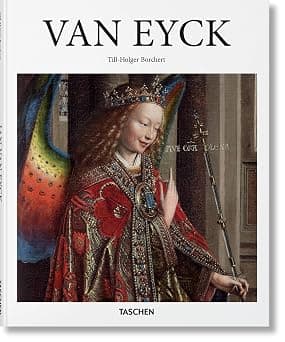 Further reading: Van Eyck (Basic Art) — Till-Holger Borchert
Palette
The colours reconstructed for this artist, with the reasoning behind each.
Pigments used: Vermilion · Madder and the red lakes · Verdigris · Orpiment · Lead-tin yellow · Gold leaf · Ultramarine · Ochre · Lead white · Umber · Lamp black