Albrecht Dürer
1471–1528German · Northern Renaissance 1420–1580
The first artist in Europe to become famous through printing, the first to paint a proper self-portrait as an independent subject, and the man who carried Italian theory across the Alps in his luggage.
Formation
Son of a Nuremberg goldsmith, trained in metalwork before painting, which explains the engraving: the discipline of the burin is a goldsmith's discipline. He apprenticed with Michael Wolgemut, travelled as a journeyman, and made two decisive trips to Italy, in 1494 and 1505, where he encountered Venetian colour and Italian proportion theory and returned determined to give German art a theoretical basis. He wrote treatises on measurement, fortification and human proportion, and corresponded with Raphael.
Technique
Two entirely separate practices. As a printmaker he pushed engraving and woodcut to a level of tonal control nobody had reached, building value from pure line — Melencolia I and Knight, Death and the Devil are the demonstration pieces, and the Apocalypse woodcuts made him internationally famous before he was thirty. As a painter he worked in the Netherlandish manner, on panel with fine glazes over meticulous underdrawing, but with a hardness of contour that comes straight from the engraved line. His watercolours of landscape and animals, made for himself and not for sale, are technically centuries early: the Great Piece of Turf is a botanical study treated as a finished work.
The palette
Clear, cool and precise, with the Italian journeys visible in it — the later panels use richer blues and a fuller range than the earlier ones. He was a careful and well-informed buyer of materials, complained in letters about the cost of ultramarine, and his portraits balance strong local colour against a dark neutral ground so that the head reads with the clarity of an engraving. In the graphic work the palette is one colour, and the tonal range is achieved entirely by the density of lines.
Legacy
He established the printed image as a way for an artist to reach an audience directly, and he was fiercely protective of it — his 1511 legal action over copied woodcuts is among the earliest recorded disputes over reproduction rights. His monogram was forged extensively in his own lifetime, which is its own measure of status.
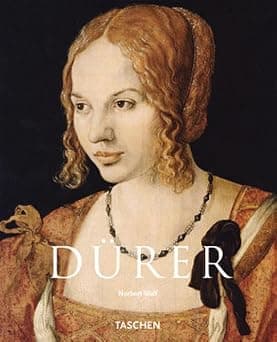 Further reading: Albrecht Durer (Taschen Basic Art Series) — Norbert Wolf
Palette
The colours reconstructed for this artist, with the reasoning behind each.
Pigments used: Umber · Sienna · Ochre · Lamp black · Azurite · Green earth · Verdigris · Sap green
Also in this era
Working at the same time
Elsewhere in the atlas, in other movements and other media, these were the hands at work during the same years.