Leonardo da Vinci
1452–1519Italian · High Renaissance 1490–1527
Leonardo painted perhaps fifteen pictures in forty years, left most of them unfinished, and changed what painting was capable of. His contribution to colour is a technique for making edges disappear.
Formation
Apprenticed around 1466 to Andrea del Verrocchio in Florence, a workshop that trained him as a sculptor and metalworker as much as a painter — Verrocchio's shop cast bronze, made tombs and took on whatever came in. That breadth matters: Leonardo approached paint as a material problem, and his notebooks treat pigment, optics and anatomy as branches of the same enquiry. He worked in Milan for Ludovico Sforza from 1482, returned to Florence, and died in France in 1519 as a guest of François I.
Technique
His method was slow beyond commercial reason. Over a pale ground he laid a greenish-grey verdaccio underpainting, then built flesh in successive translucent glazes of oil, some of them recorded by analysis as under two micrometres thick — thinner than a human hair by a factor of thirty. The Mona Lisa carries perhaps thirty such layers. Because each is transparent, light passes through the whole stack and reflects back off the ground, which is why the surface seems to glow from within rather than sit on top. Sfumato, his term, means "like smoke": no line, no boundary, one tone dissolving into the next. It only works with an oil medium slow enough to be blended for days, and it is the reason he abandoned fresco, which sets in hours — the disastrous Last Supper was an attempt to paint a wall in a technique the wall could not hold, and it began deteriorating within his lifetime.
The palette
Restrained to the point of austerity. Earth pigments, lead white, a little vermilion, and ultramarine reserved for distance rather than display — Leonardo used the most expensive blue in Europe to render the fact that far-off things look bluer, an observation he called aerial perspective and was the first to state systematically. There is almost no bright colour in his mature work. The drama is entirely in value and edge, and the palette is deliberately narrow so that nothing competes with the modelling.
Legacy
Sfumato became the central problem of European painting for three centuries — how to lose an edge — and the technique of glazing over a monochrome underpainting became standard practice from Venice to Antwerp. His unfinished panels, particularly the Adoration of the Magi, are among the most studied objects in art history precisely because they show the layers before they closed.
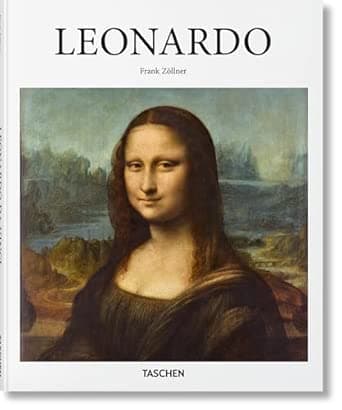 Further reading: Leonardo (Basic Art Series 2.0) — Frank Zöllner
Palette
The colours reconstructed for this artist, with the reasoning behind each.
Pigments used: Umber · Ochre · Lead white · Lamp black · Ultramarine · Green earth · Lead-tin yellow
Lexicon: Color Temperature
Also in this era
Working at the same time
Elsewhere in the atlas, in other movements and other media, these were the hands at work during the same years.