Titian
1488–1576Italian (Venetian) · Venetian Renaissance 1510–1576
Titian painted for seventy years and ended up inventing the idea that a brushstroke can be visible on purpose. His late work was considered unfinished by contemporaries and looks, from four centuries away, like the beginning of modern painting.
Formation
Trained in Venice under the Bellini and then alongside Giorgione, whose manner he absorbed so completely that the authorship of several early pictures is still disputed. He took over as the leading painter of the Republic after Giorgione's death in 1510 and Bellini's in 1516, and spent the rest of a very long life supplying Charles V, Philip II and the Venetian church with work, dying in 1576 during an outbreak of plague.
Technique
Venice painted on canvas rather than panel, because the lagoon damp destroyed wood, and canvas changed everything: it has a tooth, it takes a loaded brush, and it permits a scale that a panel cannot. Titian built up a picture in opaque underpainting and then worked over it in glazes, but unlike the Florentines he did not conceal the making. His pupil Palma Giovane described him laying in a picture with a mass of colour, turning it to the wall for months, then returning to it "as if it were a mortal enemy". In the late work he applied paint with his fingers as much as with brushes, and the surface is a visible record of decisions rather than a window onto a scene.
The palette
The richest colour available in Europe, because Venice was the port where it arrived. Ultramarine from the Levant, lakes from the dye trade, orpiment, realgar and the full range of the Venetian colour merchants — his suppliers were the same vendecolori who served the glass and textile industries. His method is layered: a body colour of vermilion or red ochre under a lake glaze, warm over cool, so that reds have depth rather than flatness. The Assumption altarpiece is the demonstration piece, and the reds in it are constructed from at least three separate materials.
Legacy
The Venetian tradition of colour and open handling passes through Rubens and Velázquez to Delacroix and eventually to the Impressionists, and the entire colore-versus-disegno argument that organised European art theory for centuries is essentially an argument about whether Titian or Michelangelo was right. His late canvases were dismissed as failing eyesight for a long time before anyone considered they might be intentional.
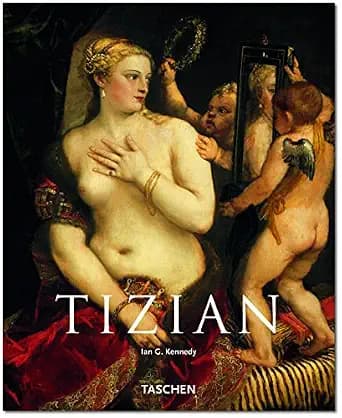 Further reading: Titian (Taschen Basic Art) — Ian G. Kennedy
Palette
The colours reconstructed for this artist, with the reasoning behind each.
Pigments used: Vermilion · Orpiment · Lead-tin yellow · Ochre · Lead white · Ultramarine · Umber · Bitumen · Verdigris
Lexicon: Pigment · Imprimatura · Lake · Color Temperature
Also in this era
Working at the same time
Elsewhere in the atlas, in other movements and other media, these were the hands at work during the same years.