Michelangelo Buonarroti
1475–1564Italian · High Renaissance 1490–1527
A sculptor who insisted he was not a painter, handed a ceiling of six hundred square metres and no fresco experience worth the name. What he produced there is the most consequential colour in Western art, and for four centuries nobody knew what it actually looked like.
Formation
Trained briefly with Domenico Ghirlandaio, the most accomplished fresco workshop in Florence, before moving into the Medici sculpture garden — his own account minimises the painting apprenticeship, which he spent the rest of his life insisting had never really happened. He was thirty-three and known as the sculptor of the David when Julius II gave him the Sistine commission in 1508, an assignment he tried to refuse and later described as a trap laid by rivals.
Technique
Buon fresco, on wet lime plaster, which permits no hesitation: the painter has one working day, a giornata, before the plaster sets, and nothing can be corrected afterwards without cutting the wall out and starting again. The Sistine ceiling divides into several hundred such days, and the seams are visible under raking light. He worked standing, head back, on scaffolding of his own design, and the technique forced a way of painting entirely opposed to Leonardo's: no glazes, no slow blending, colour applied at full strength and modelled by hatching directly into the wet surface. His forms are sculptural because he was thinking as a carver — figures are lit as if by a raking studio light and turned in space like objects.
The palette
Fresco restricts the palette to pigments that survive lime, which excludes most of the expensive ones: lead white blackens, azurite fails, and the great blues cannot be used at all. What remains is earths, lime white, and the mineral colours that tolerate alkali. Within that constraint he did something unexpected — the cangiante technique, where a fold shifts not from light to dark but from one hue to another, orange into green, rose into acid yellow, because a fresco painter cannot darken a colour without dirtying it. The 1980s cleaning removed centuries of candle soot and animal glue and revealed those shifts at a saturation that shocked the field; art historians had built an entire account of Michelangelo as a sombre tonalist on top of what turned out to be dirt.
Legacy
The ceiling made the human body the sole vehicle of meaning in European painting, and the cangiante palette fed directly into Mannerism — Pontormo and Rosso took the acid colour and none of the anatomy. The cleaning controversy, still not entirely settled, is the most public argument conservation has ever had about how much of a painting is the painting.
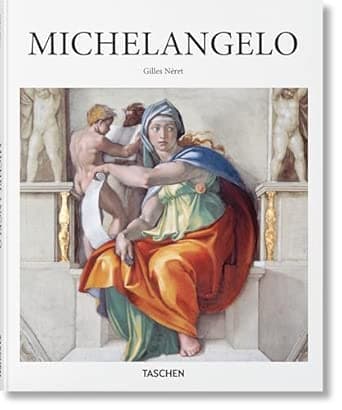 Further reading: Michelangelo (Basic Art) — Gilles Néret
Palette
The colours reconstructed for this artist, with the reasoning behind each.
Pigments used: Ultramarine · Ochre · Lime white · Green earth · Malachite · Sienna
Essays: Why old paintings look brown
Also in this era
Working at the same time
Elsewhere in the atlas, in other movements and other media, these were the hands at work during the same years.