Pieter Bruegel the Elder
1525–1569Flemish · Northern Renaissance 1420–1580
He was called Peasant Bruegel for centuries on the assumption that a man who painted villagers must have been one. He was a literate humanist with sophisticated patrons, and the condescension says more about his audiences than about him.
Formation
Trained in Antwerp, admitted to the guild in 1551, and travelled to Italy and across the Alps in the early 1550s — a journey that produced no Italianate figures at all but transformed his landscape completely. The mountain drawings he brought back supplied him with an idea of scale he used for the rest of his life. He worked for the print publisher Hieronymus Cock, designing engravings for a mass market, before moving to Brussels in 1563 and concentrating on painting.
Technique
Panel, thin ground, and an economy learned from print design. He composed in clear tonal zones so that a picture reads at a distance before it resolves into hundreds of individual incidents, and the transitions between foreground, middle and far distance are handled by shifting the colour temperature rather than by aerial blur. He also painted a number of works in tempera on unprimed linen, a fragile technique used for cheap wall hangings, of which very few survive. The figures are constructed with extraordinary economy: a peasant's back and the angle of a shoulder do the work that another painter would need a face for.
The palette
Cool, clear and organised by season. The Hunters in the Snow works because the entire picture is held in a narrow green-blue range with the warm accents of fire, dogs and brick placed at intervals across it, and the seasonal cycle to which it belongs demonstrates a deliberate colour scheme for each month. Earths, lead white, azurite, lead-tin yellow and copper greens. He rarely reaches for expensive pigment, and the effect is achieved by tonal organisation rather than by material.
Legacy
He effectively invented the peasant genre and the panoramic winter landscape, both of which became staples of Netherlandish painting for a century, largely through his sons — Pieter the Younger made a career copying him. The Months cycle is the point at which landscape stops being a background and becomes the subject.
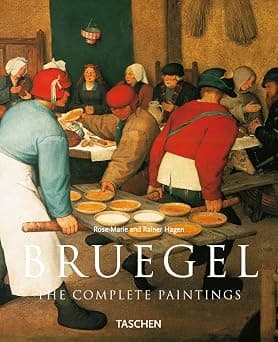 Further reading: Bruegel — Rose-Marie & Rainer Hagen (Taschen Basic Art)
Palette
The colours reconstructed for this artist, with the reasoning behind each.
Pigments used: Azurite · Lead white · Lamp black · Red lead · Madder and the red lakes · Ochre · Sienna · Verdigris
Also in this era
Working at the same time
Elsewhere in the atlas, in other movements and other media, these were the hands at work during the same years.