El Greco
1541–1614Greek-Spanish · Baroque Chiaroscuro 1590–1680
A Cretan icon painter who trained in Venice, failed in Rome, and found in Toledo a city willing to accept the strangest painting produced in Europe before the twentieth century. For three hundred years the elongations were explained as an eye defect.
Formation
Doménikos Theotokópoulos began as a painter of Byzantine icons on Crete, then under Venetian rule, and was already a master in that tradition before he arrived in Venice around 1567 and encountered Titian and Tintoretto. He moved to Rome, where he reportedly offered to repaint the Sistine ceiling and made himself unwelcome, and settled in Toledo in 1577. He never worked for the Spanish court after Philip II rejected a commissioned altarpiece, and remained a provincial painter with a local clientele of clerics and intellectuals.
Technique
Icon logic executed in Venetian oil. The icon tradition does not describe space naturalistically; it organises a surface around a spiritual hierarchy, and El Greco never abandoned that even as he adopted oil, canvas and Venetian handling. He worked on dark grounds with rapid, slashing brushwork, building figures out of cold white highlights struck over transparent shadow. The elongation is not a defect of vision — the compositions are constructed, the figures are proportioned consistently, and drawings show the same distortions deliberately built up. He was also working for high, narrow altarpiece spaces where extreme verticality reads correctly from below.
The palette
Cold, acid and unlike anything around him. Ultramarine and azurite pushed toward violet, lakes, vermilion, lead-tin yellow, and a livid green-grey in the flesh that gives his saints their unearthly complexion. He glazes cold over warm — the reverse of standard Venetian practice — and the whites are struck in as sharp cold accents rather than fused into the modelling. The result is a colour that reads as artificial light or as vision rather than as daylight, which is presumably the intention.
Legacy
Forgotten and considered mad until the late nineteenth century, then adopted with enthusiasm by the modernists: Cézanne, the Expressionists and above all Picasso, whose Demoiselles owes a direct debt to the Opening of the Fifth Seal. He is the clearest case in this atlas of an artist whose reputation depended entirely on the arrival of an audience that could read him.
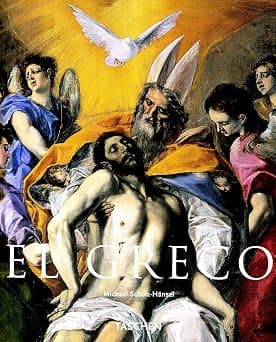 Further reading: El Greco (Taschen Basic Art Series) — Michael Scholz-Hänsel
Palette
The colours reconstructed for this artist, with the reasoning behind each.
Pigments used: Azurite · Green earth · Lead white · Lamp black · Vermilion · Madder and the red lakes · Ochre · Ultramarine · Orpiment · Lead-tin yellow · Bone black
Also in this era
Working at the same time
Elsewhere in the atlas, in other movements and other media, these were the hands at work during the same years.