Francisco de Zurbarán
1598–1664Spanish · Baroque Chiaroscuro 1590–1680
He painted monks, saints and a handful of ceramic vessels on a shelf, and the still lifes are as severe and as still as the saints. Zurbarán is the painter of Spanish austerity, and he was ruined by a change in fashion.
Formation
From a village in Extremadura, apprenticed in Seville to a maker of painted religious statues — which matters, because his figures have the frontality and the carved presence of polychrome sculpture. He worked mainly for monastic orders, which supplied him with steady commissions for series of saints and monks, and much of his output went to convents in Spain and to the colonies in the Americas. Murillo's softer, warmer manner displaced him in Sevillian taste in the 1650s, and he died in Madrid in relative poverty.
Technique
A dark ground, a single directional light and no atmosphere at all. Zurbarán isolates a figure against near-blackness with almost no setting, and models it with a hard, sculptural light that describes the fall of cloth with obsessive attention. His whites are the technical marvel: a Carthusian habit is built in lead white over a grey underlayer with the folds established by value alone, and no two whites in a picture are the same white. The paint is applied fairly thickly and smoothly, with less glazing than his Italian contemporaries, giving surfaces a matte, dry, tactile quality that suits the subject.
The palette
Extremely narrow, and the narrowness is the argument. Lead white, bone black, earths, a little vermilion, occasional lake and blue in a Virgin's mantle where the iconography requires it. The still lifes are painted almost entirely in white, ochre, brown and black. Because the range is so restricted, any colour that does appear — the crimson of a martyr's robe, a yellow-glazed pot — arrives with disproportionate force, and he uses that economy deliberately.
Legacy
The isolated object against a dark ground, with light doing all the descriptive work, is a compositional idea that reappears in Chardin, in Manet's still lifes, and in twentieth-century painting and photography. His still lifes, few in number, are among the most reproduced images in Spanish art. The monastic series scattered across museums and churches are still being reassembled by scholars.
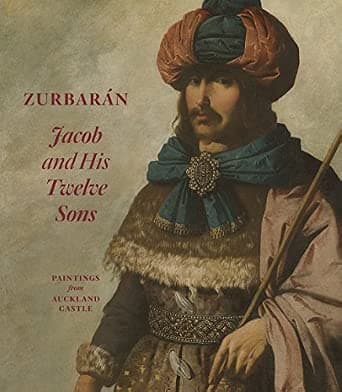 Further reading: Zurbaran: Jacob and His Twelve Sons, Paintings from Auckland Castle — Susan Grace Galassi, Edward Payne, Mark A. Roglan
Palette
The colours reconstructed for this artist, with the reasoning behind each.
Pigments used: Ochre · Umber · Lead white · Lamp black · Bone black · Orpiment · Lead-tin yellow
Lexicon: Chiaroscuro · Value
Also in this era
Working at the same time
Elsewhere in the atlas, in other movements and other media, these were the hands at work during the same years.