Pieter de Hooch
1629–1684Dutch · Dutch Interior Light 1650–1680
For a long time his best pictures were sold as Vermeers, with the signatures altered to match. De Hooch got there first on the thing they share — the doorway that opens onto another room and then onto daylight.
Formation
Born in Rotterdam to a bricklayer and a midwife, trained in Haarlem, and employed as painter and servant to a Delft cloth merchant, which is how he arrived in the town in the early 1650s. The Delft years, roughly 1652 to 1661, are the great period. He then moved to Amsterdam chasing a wealthier market, and the work changed: grander interiors, marble floors, silk, and a steady decline in quality across the following twenty years. He died in an asylum in 1684.
Technique
Careful perspective construction, often with the vanishing point marked by a pinhole still detectable in the panel, and a systematic treatment of receding light. His signature device is the doorkijkje, the view through — a sequence of framed openings leading from a shadowed foreground room to a sunlit courtyard beyond — and it works because each zone is keyed to a different value and temperature, so the eye reads depth as a change in light rather than as converging lines. Paint handling is solid and unshowy, built up in ordinary layers, with the texture of brick, plaster and worn tile given real attention.
The palette
Warm where Vermeer is cool. Red ochre and vermilion in the brickwork and the tiled floors, lead white for the plaster and the light, earths throughout, with blue used sparingly as an accent in an apron or a jacket rather than as the governing note. The Delft pictures balance a warm interior against a cooler exterior seen through the doorway, and that temperature contrast is what produces the sense of open air at the end of the sequence.
Legacy
The Delft interior as a subject — domestic order, natural light, a woman occupied with something ordinary — is as much his invention as Vermeer's, and the influence runs forward to nineteenth-century Danish painting and to Hammershøi. His nineteenth-century reputation was higher than Vermeer's until it wasn't.
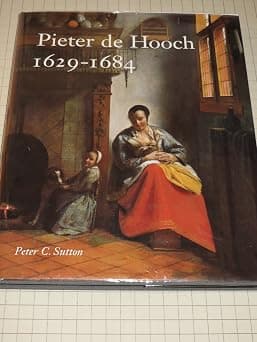 Further reading: Pieter de Hooch 1629-1684 — Peter Sutton (Yale University Press)
Palette
The colours reconstructed for this artist, with the reasoning behind each.
Pigments used: Ochre · Sienna · Lead white · Lead-tin yellow · Umber · Azurite
Also in this era
Working at the same time
Elsewhere in the atlas, in other movements and other media, these were the hands at work during the same years.