Jan Steen
1626–1679Dutch · Dutch Interior Light 1650–1680
A Jan Steen household is still a Dutch expression for a chaotic one. He painted disorder so convincingly that his own reputation never recovered — for two centuries he was assumed to be the drunk in his own pictures.
Formation
From a Leiden brewing family, university-registered, trained possibly under Jan van Goyen, whose daughter he married. He worked in Leiden, The Hague, Delft, Warmond and Haarlem, ran a brewery for a period and later held a tavern licence, which is documented fact and became the basis of a great deal of unfounded biography. He was prolific, with around three hundred and fifty surviving paintings, and he was well read: the pictures are full of proverbs, theatrical conventions and moralising devices that assume an educated viewer.
Technique
Fluent, fast and far more sophisticated than the subjects suggest. He worked thinly on panel and canvas with a loaded brush and considerable variation of touch — a face resolved carefully, a sleeve laid in with three strokes — and he manages large multi-figure compositions without them falling into confusion. The staging is theatrical in a precise sense: figures are arranged as if on a stage, several address the viewer directly, and the compositions borrow from the rederijker theatre he would have known. Everything that looks accidental is placed.
The palette
Warm, mid-toned and deliberately ordinary, with strong local colour used to organise a crowded scene. Vermilion and red lake in a jacket, lead-tin yellow in a skirt, earths and lead white throughout, and blue used sparingly. His skill is in keeping a dozen bright notes legible against each other without the picture becoming noisy, which he does by dropping the surroundings to a low warm key and letting only three or four colours reach full strength.
Legacy
The comic genre scene was long ranked at the bottom of the academic hierarchy, and Steen suffered for it more than most. Modern reappraisal has taken the moral structure of the pictures seriously and treated the disorder as an argument rather than a report, which is much closer to how a seventeenth-century viewer would have read them.
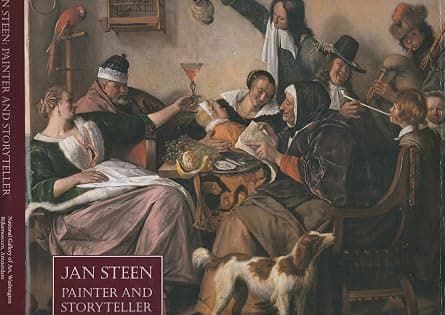 Further reading: Jan Steen: Painter and Storyteller — H. Perry Chapman, Wouter Th. Kloek, Arthur K. Wheelock Jr. (Yale University Press)
Palette
The colours reconstructed for this artist, with the reasoning behind each.
Pigments used: Vermilion · Red lead · Ochre · Orpiment · Lead-tin yellow · Umber · Lead white · Green earth · Verdigris · Lamp black
Also in this era
Working at the same time
Elsewhere in the atlas, in other movements and other media, these were the hands at work during the same years.