Diego Velázquez
1599–1660Spanish · Baroque Chiaroscuro 1590–1680
He spent most of his career as a palace official, painting slowly and rarely, and produced in Las Meninas the picture that more art historians have written about than any other. Manet called him the painter of painters.
Formation
Trained in Seville under Francisco Pacheco, a pedantic theorist whose treatise is nonetheless the main source for his early years, and whose daughter he married. He went to Madrid in 1623, painted Philip IV, and was appointed court painter at twenty-four — a post he held for the rest of his life, along with increasingly senior household offices that consumed his time. Two long journeys to Italy, in 1629 and 1649, changed the work decisively; the second produced the portrait of Innocent X, of which the sitter is said to have remarked that it was troppo vero, too truthful.
Technique
Optical rather than descriptive. The early Seville work is dark, tight and Caravaggesque; the late work dissolves. Velázquez discovered that a form can be rendered by placing the correct value and temperature next to another correct value, without drawing the object at all — up close, a hand in Las Meninas is a handful of unrelated strokes, and at three metres it is a hand. He worked on a light ground in the mature period, thinly, with long fluid brushes, and left the weave of the canvas visible through the paint. There is very little glazing and very little correction; the touch is placed once.
The palette
Silvery, cool and extremely restrained. Lead white, ochres, umber, bone black, vermilion, red lake, and azurite or smalt used sparingly — this is not a rich palette by seventeenth-century court standards, and its restraint is a choice, since he had a king's budget. The greys are what matter: he built an enormous range of neutrals from black, white and earth, and the silver-grey atmosphere that fills the late royal portraits is the result. Colour appears as a small area of intensity against that field, which is why a red sash or a pink ribbon carries so much weight.
Legacy
Manet and the Impressionists went to the Prado specifically to look at him, and the loose, optical, alla prima handling of nineteenth-century modernism traces directly to those canvases. Las Meninas has generated a literature of its own — on the mirror, the sightlines, and who exactly is standing where the viewer stands — and Picasso painted fifty-eight variations of it in a single year.
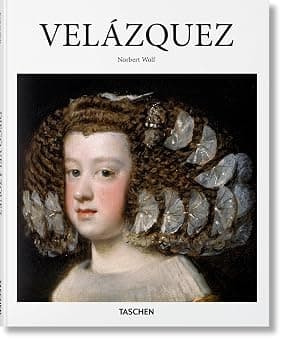 Further reading: Velázquez (Basic Art) — Norbert Wolf
Palette
The colours reconstructed for this artist, with the reasoning behind each.
Pigments used: Lead white · Lamp black · Bone black · Vermilion · Ochre · Azurite · Green earth
Lexicon: Imprimatura
Also in this era
Working at the same time
Elsewhere in the atlas, in other movements and other media, these were the hands at work during the same years.