Peter Paul Rubens
1577–1640Flemish · Baroque Chiaroscuro 1590–1680
Painter, scholar, and working diplomat who negotiated a peace treaty between Spain and England. He ran the most efficient painting business in Europe and produced something like fourteen hundred works, which is only possible because he industrialised the studio.
Formation
Raised in Antwerp, classically educated and fluent in several languages, he spent eight formative years in Italy from 1600 in the service of the Duke of Mantua, copying Titian and studying antiquity. He returned in 1608, was appointed court painter to the Spanish regents of the Netherlands, and built a house and studio that functioned as a factory, a museum and a diplomatic residence at once. He was knighted by both Philip IV and Charles I.
Technique
A production system as much as a technique. Rubens made the oil sketch — the modello — into a working instrument: a small, brilliantly fluid panel that established the whole composition in colour, which assistants then enlarged onto the final canvas, with the master returning to paint the heads and hands and to unify the surface. He priced work explicitly by how much of it he had touched. His own handling is fast, transparent and built on a streaky pale imprimatura, often a warm grey brushed on so thinly that the wood grain shows through and functions as a mid-tone. He glazed rather than blended, keeping the paint film thin, which is why his surfaces have survived so well.
The palette
Full and warm, and organised around flesh. He recorded his own recipe for skin — a foundation of lead white with a little red and yellow ochre, cooled with black in the half-tones, warmed with vermilion and lake in the transitions — and the celebrated luminosity comes from applying it thinly over that light ground so the panel glows through. Azurite and ultramarine in the draperies and skies, lead-tin yellow, madder and vermilion. Nothing is dull, and the whole surface stays in motion.
Legacy
The Baroque figure in movement, the diagonal composition and the treatment of flesh as light rather than as substance all descend from him, and the influence runs directly to Watteau, Delacroix and Renoir. Delacroix filled notebooks with his colour. The oil sketch, which he turned into a category of its own, is now often more admired than the finished machines it served.
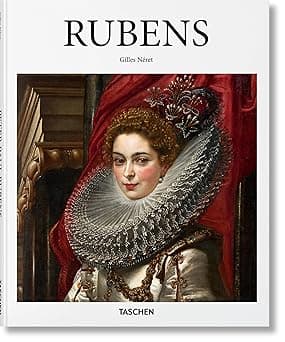 Further reading: Rubens (Basic Art) — Gilles Néret
Palette
The colours reconstructed for this artist, with the reasoning behind each.
Pigments used: Vermilion · Ochre · Lead white · Azurite · Madder and the red lakes · Lamp black · Lead-tin yellow · Umber
Lexicon: Ground · Imprimatura