Caravaggio
1571–1610Italian · Baroque Chiaroscuro 1590–1680
He killed a man, fled Rome under sentence of death, and painted the most influential pictures of the seventeenth century in the intervals. Caravaggio's innovation is that he removed the light from everywhere except one place.
Formation
Trained in Milan under a former assistant of Titian, arrived in Rome in his early twenties with nothing, and worked painting flowers and fruit in other men's studios before Cardinal Del Monte took him into his household. The Contarelli Chapel commission in 1599 made him famous immediately and permanently. His court records are extensive — assault, libel, carrying a sword without licence — and in 1606 he killed Ranuccio Tomassoni and left Rome for Naples, Malta and Sicily, dying on a beach in 1610 at thirty-eight.
Technique
A dark ground and no preparatory drawing. Caravaggio painted directly from posed models onto a reddish-brown or near-black priming, working the figure up out of the darkness with lead white, and X-rays show no underdrawing of the conventional kind — instead there are incisions scored into the wet ground with the brush handle, marking the position of a head or a hand so the model could be replaced in the same pose. No cartoons, no squaring up, no studio idealisation. The result is a figure that appears carved out of the dark by a single hard light source falling from above left, which is the effect the whole seventeenth century then tried to reproduce.
The palette
Deliberately small. Earths, lead white, vermilion, red lakes, bone black and very little else — analysis of his pictures repeatedly turns up a palette a provincial painter could have afforded. There is almost no blue, partly because ultramarine is expensive and partly because blue would open the darkness back up. The colour lives in the flesh: warm ochres and lakes brought to full brightness where the light strikes, dropping into transparent brown shadow within a few centimetres. The dark ground does the rest of the work, and it does it economically.
Legacy
Caravaggism spread across Europe within a decade — Utrecht, Naples, Spain, France — and the dark ground with a single raking light became the default machinery of Baroque drama. Then his reputation collapsed almost entirely for two centuries, dismissed as vulgar naturalism, and was only rebuilt in the twentieth. There is a technical cost, too: those dark grounds have grown more transparent with age, and in many of his followers the shadows have swallowed detail the painter intended to be visible.
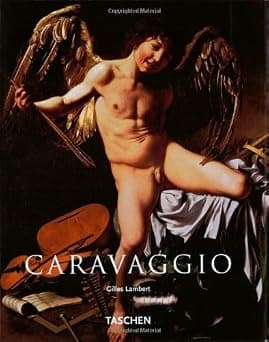 Further reading: Caravaggio, 1571-1610 (Taschen Basic Art Series) — Gilles Lambert
Palette
The colours reconstructed for this artist, with the reasoning behind each.
Pigments used: Ochre · Lead white · Vermilion · Verdigris · Lamp black · Sienna
Essays: Painting with light
Lexicon: Tint, Shade, Tone · Ground · Chiaroscuro · Value
Also in this era
Working at the same time
Elsewhere in the atlas, in other movements and other media, these were the hands at work during the same years.