Johannes Vermeer
1632–1675Dutch · Dutch Interior Light 1650–1680
Thirty-four surviving paintings, a lifetime spent in one small town, and a habit of using the most expensive pigment in Europe in places where nobody would ever see it. Vermeer died insolvent, leaving eleven children and a widow who blamed the war.
Formation
Born in Delft, where he stayed. His father was an innkeeper and art dealer, and Vermeer inherited the business — much of his income likely came from dealing rather than painting, which is just as well at two or three pictures a year. He joined the Guild of Saint Luke in 1653 and served twice as its head, so he was a respected figure locally, but he was almost unknown outside Delft and was thoroughly forgotten until the French critic Théophile Thoré-Bürger reassembled the œuvre in the 1860s.
Technique
He built pictures the traditional Netherlandish way — dead-colouring, then working up, then glazing — but with two peculiarities. The first is the pointillé: small dots of thick lead white laid over a finished passage to imitate the way a highlight blooms and blurs, on bread crust, on a brass nail, on the pearls. That is not how the eye sees an edge, it is how a lens does, and it is the strongest evidence in the paintings themselves for the long-argued case that he used a camera obscura. The second is the underlayer: analysis has repeatedly found expensive pigment buried where it cannot be seen directly, tinting the layers above from below.
The palette
Natural ultramarine, used with an extravagance that is difficult to explain economically. He put it in the shadows of a white wall, into the greys, into the ground beneath flesh — the cool light that fills his interiors is partly a physical fact of the paint, not just an observation. Alongside it, lead white, lead-tin yellow, madder lake, vermilion, ochres and green earth. The famous yellow jacket is lead-tin yellow; the blue-and-yellow pairing that recurs across the œuvre is the most expensive and the most reliable pigment in his cupboard, set against each other.
Legacy
His rediscovery reshaped the canon in the space of a few decades, and the intimacy and stillness of the interiors became a reference point for photography as much as for painting. The Han van Meegeren forgery scandal of the 1940s — fakes accepted by the leading experts and sold to Göring — is the strangest chapter of that afterlife.
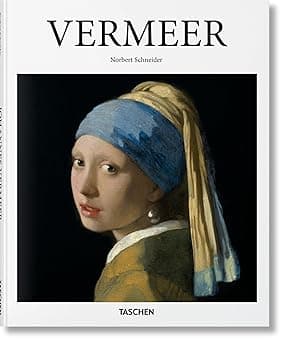 Further reading: Vermeer (Basic Art) — Norbert Schneider
Palette
The colours reconstructed for this artist, with the reasoning behind each.
Pigments used: Ultramarine · Lead white · Lead-tin yellow · Ochre · Bone black · Vermilion
Essays: Painting with light · Why old paintings look brown
Lexicon: Pigment · Ground · Lake · Color Harmony
Also in this era
Working at the same time
Elsewhere in the atlas, in other movements and other media, these were the hands at work during the same years.