Hieronymus Bosch
1450–1516Netherlandish · Northern Renaissance 1420–1580
Five centuries of viewers have tried to decode him and the readings contradict each other completely — heretic, moralist, satirist, alchemist, orthodox Catholic. What is certain is the paint: fast, thin and startlingly modern in handling.
Formation
Born and dead in 's-Hertogenbosch, from which he took his name, into a family of painters spanning several generations. He joined the Brotherhood of Our Lady, a respectable local confraternity, and worked for prominent patrons including Philip the Handsome — none of which fits the image of a marginal visionary. Little else is documented; there are no letters, no treatises, no recorded statements, and the interpretive vacuum is much of why the paintings attract so much theory.
Technique
The opposite of van Eyck. Where Netherlandish practice built up many slow glazes, Bosch worked alla prima on a thin white chalk ground, laying in a rapid brush underdrawing — visible in infrared and often quite different from the final image — and painting directly with fluid, economical strokes. Many passages are a single layer. This is why the surfaces are thin, why the panels have aged unusually well, and why the figures have a nervous vitality: the mark is the first and only decision. Recent conservation on the Garden of Earthly Delights confirmed how much of the picture is one pass.
The palette
Limited and bright, chosen for speed rather than richness. Earths, lead white, vermilion, azurite, lead-tin yellow and copper greens, applied thinly so that the white ground illuminates them from beneath. The overall key is high and slightly acid, which is part of the unsettling effect: a scene of torment painted in the clear light of a spring morning. The blues have retained their intensity because they sit over white rather than being mixed into it.
Legacy
Bruegel absorbed him directly and the demonic imagery was copied and pastiched for a century. The Surrealists claimed him as an ancestor in the 1920s, which is anachronistic but not entirely wrong about the pictorial logic — Bosch composes by association rather than by narrative, and the eye moves through the panels without a governing hierarchy.
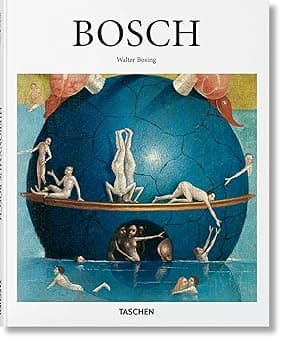 Further reading: Bosch — Walter Bosing (Taschen Basic Art)
Palette
The colours reconstructed for this artist, with the reasoning behind each.
Pigments used: Vermilion · Red lead · Verdigris · Malachite · Lamp black · Bone black · Ochre · Lead white · Azurite · Umber
Also in this era
Working at the same time
Elsewhere in the atlas, in other movements and other media, these were the hands at work during the same years.