Gustav Klimt
1862–1918Austrian · Vienna Secession & Expressionism 1897–1920
He put real gold leaf on canvas at a moment when European painting was busy abolishing everything decorative, and produced in The Kiss an image that has been reproduced on more objects than almost any painting in existence.
Formation
Son of a gold engraver, trained at the Vienna School of Applied Arts rather than the Academy — a decorative-arts education, which explains everything about how he treats a surface. He began with conventional and highly successful architectural decoration, then broke from the establishment: in 1897 he led the founding of the Vienna Secession, and his ceiling paintings for the University of Vienna caused such an outcry over their eroticism and pessimism that he returned the fee and kept the pictures.
Technique
Two incompatible techniques held in one picture. The faces and hands are modelled naturalistically, with soft tonal transitions; everything else is flat pattern — gold leaf, silver, spirals, rectangles, eyes, applied as ornament with no spatial depth at all. He used real metal leaf laid over the canvas, sometimes with gesso relief beneath it, which is a technique from icon painting and Byzantine mosaic rather than from easel painting. He saw the mosaics at Ravenna in 1903, and the Golden Phase follows immediately. The landscapes, painted in square format on holiday, are the opposite: dense all-over fields of small strokes with no ornament whatsoever.
The palette
Gold, and then everything else. The metal leaf is not a colour but a reflective surface, so it changes as the viewer moves and cannot be reproduced accurately in print — the paintings do something in a room that photographs cannot show. Around it he used strong saturated colour in flat areas: viridian and emerald, cobalt and ultramarine, vermilion and lake, cadmium yellow, with the flesh kept pale and cool so it separates from the ornament.
Legacy
The Secession broke the Academy's monopoly in Vienna and its building still carries the motto "to every age its art, to art its freedom". Schiele and Kokoschka came directly out of his orbit. The paintings also carry a difficult provenance history: several were looted under the Nazi regime, and the restitution of Adele Bloch-Bauer I to Maria Altmann after a decade of litigation is among the most significant art restitution cases ever decided.
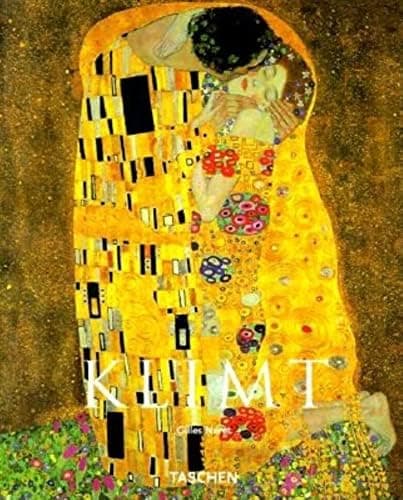 Further reading: Klimt (Basic Art) — Gilles Néret
Palette
The colours reconstructed for this artist, with the reasoning behind each.
Pigments used: Ochre · Gold leaf · Ultramarine · Cobalt blue · Vermilion · Cadmium red · Cadmium yellow · Viridian · Chrome green · Lead white · Lamp black · Bone black
Lexicon: Color Harmony
Also in this era
Working at the same time
Elsewhere in the atlas, in other movements and other media, these were the hands at work during the same years.