John Singer Sargent
1856–1925American · 19th-Century Realism & Tonalism 1850–1910
The most sought-after portraitist in the English-speaking world, who got there after a scandal nearly ended his career, and who abandoned portraiture at the height of it because he had come to loathe it. He called them "a pimp's profession".
Formation
Born in Florence to American parents who moved perpetually around Europe, so he grew up multilingual and without a fixed home. He trained in Paris under Carolus-Duran, who taught a direct alla prima method derived from Velázquez, and travelled to Spain in 1879 specifically to copy in the Prado. Madame X, exhibited in 1884, caused a scandal over a fallen shoulder strap and enough insinuation to drive him out of Paris to London, where he rebuilt the career entirely.
Technique
Direct painting, wet into wet, with an economy that borders on showing off. Sargent worked from a prepared tonal ground and placed strokes at full strength in the correct value and temperature, adjusting as little as possible — the famous test is that a passage in a Sargent, isolated, is an unreadable smear that resolves into satin or a knuckle at conversational distance. He would scrape a head off and repaint it entirely rather than correct it, sometimes dozens of times. His watercolours, made for himself on holiday, are as fluent as anything in the medium.
The palette
Rich, warm and centred on flesh and fabric. Lead white, ochres, vermilion, cadmiums, viridian, ivory black and blues used as much for cooling as for colour — his famous blacks are constructed, not straight from a tube, and a black dress in a Sargent contains blue, brown and green. He learned from Velázquez that a restricted palette with impeccable values beats a full one with approximate ones, and the late Alpine watercolours show him working the opposite extreme with almost pure transparent colour.
Legacy
The bravura portrait tradition effectively ends with him. His late murals for the Boston Public Library occupied decades and are largely unregarded; his reputation collapsed with modernism and was rebuilt from the 1980s onward, now standing on the watercolours and the informal work as much as on the society portraits. Gassed, painted after he witnessed the aftermath of a mustard gas attack in 1918, is the exception to everything else in his output.
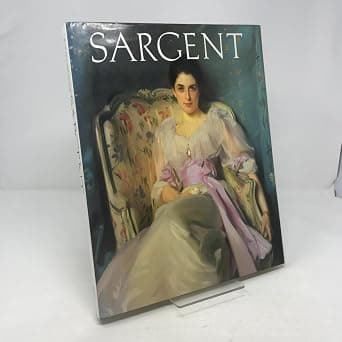 Further reading: John Singer Sargent — Carter Ratcliff
Palette
The colours reconstructed for this artist, with the reasoning behind each.
Pigments used: Bone black · Vermilion · Ochre · Lead white · Zinc white · Alizarin crimson · Cadmium red · Umber · Lamp black · Cadmium yellow · Viridian
Also in this era
Working at the same time
Elsewhere in the atlas, in other movements and other media, these were the hands at work during the same years.