Jean-Baptiste-Camille Corot
1796–1875French · 19th-Century Realism & Tonalism 1850–1910
He painted small, luminous oil studies outdoors decades before the Impressionists and then sold soft grey landscapes to the Salon for a living. The private work turned out to be the important one, which is often how this goes.
Formation
Son of prosperous Parisian clothiers who supported him with an allowance, so he began painting at twenty-six without commercial pressure. Three long Italian journeys, from 1825, produced the plein-air oil sketches that are now regarded as his major achievement: rapid, exact studies of light on stone, painted on paper or small panels in a single session. He exhibited at the Salon for decades and became, by the 1850s, both successful and famously generous — he supported Daumier when he went blind and Millet's widow.
Technique
Two practices held apart. The Italian studies are direct, alla prima, painted fast in flat masses of tone, with the structure of a building established by three values and no detail whatsoever — they look modern because they are entirely about light and shape. The later Salon landscapes are studio-made, worked with soft feathery touches into a silvery haze, with foliage flicked in with the tip of the brush over a warm ground. He also made a large body of figure paintings that were barely exhibited in his lifetime and which Picasso admired greatly.
The palette
Extremely narrow, and famous for it. Corot worked with a small set of earths, lead white, black, and a limited range of greens and blues, and he built enormous subtlety out of value rather than hue. The late landscapes hold almost the entire picture within a narrow band of silver-grey-green, with one or two small warm accents — a red cap on a figure — placed to activate the whole field. He advised students to establish the values first and treat colour as secondary, which is the opposite of what the next generation would do.
Legacy
The plein-air oil sketch as a serious form runs from him to Monet and Pissarro, both of whom acknowledged the debt directly. He is also, unhappily, among the most forged artists in history: he signed work by struggling friends to help them sell it, and the estimate that there are more fake Corots than real ones is old, unverifiable and probably not far off.
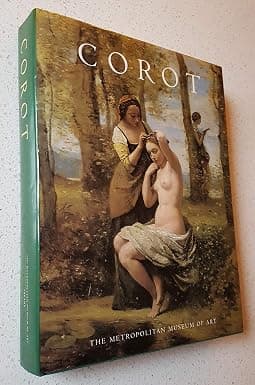 Further reading: Corot — Gary Tinterow, Michael Pantazzi, Vincent Pomarède
Palette
The colours reconstructed for this artist, with the reasoning behind each.
Pigments used: Green earth · Lead white · Lamp black · Viridian · Vermilion · Ochre · Cobalt blue · Umber · Sienna · Cadmium red
Also in this era
Working at the same time
Elsewhere in the atlas, in other movements and other media, these were the hands at work during the same years.