Winslow Homer
1836–1910American · 19th-Century Realism & Tonalism 1850–1910
He covered the American Civil War as a magazine illustrator, taught himself to paint, and ended up alone on the Maine coast painting the sea hitting rocks. There is no European equivalent for the trajectory.
Formation
Apprenticed to a Boston lithographer, which he hated, then worked as a freelance illustrator for Harper's Weekly, including two years at the front during the Civil War. The illustration training gave him a strong compositional shorthand and an eye for the telling incident. He was largely self-taught as a painter, spent a formative period in England at Cullercoats in 1881–82 painting fishing communities, and returned to settle at Prouts Neck, Maine, in 1883, increasingly withdrawn from the art world.
Technique
Two media, handled very differently. In oil he worked broadly and structurally, with simplified masses and a strong sense of the picture as a designed rectangle — the late marines are almost abstract arrangements of wave, rock and spray. His watercolours are the technical achievement: extremely fluid, worked wet-in-wet with reserved white paper doing the work of highlights, scraped and blotted, and completed rapidly outdoors. He treated watercolour as a primary medium at a time when it was widely considered a sketching tool, and the Caribbean and Adirondack sheets are among the best made anywhere.
The palette
Cool, direct and unsentimental in the marines: blue-greens, greys, white, with the warm note held back for a distant sail or a figure. The tropical watercolours are the opposite — full, saturated, transparent, using the new bright pigments and letting the paper flare through. He avoided the tonal haze fashionable in his period, keeping edges crisp and colour clean, which is part of why the work still looks blunt and modern.
Legacy
He is the central figure in American painting between the Hudson River School and modernism, and the Maine marines established a way of treating landscape as force rather than as scenery. American watercolour as a serious tradition — running to Hopper, Burchfield and beyond — starts substantially with him.
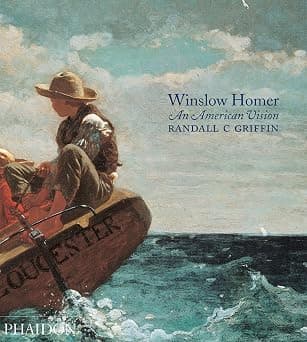 Further reading: Winslow Homer: An American Vision — Randall C. Griffin
Palette
The colours reconstructed for this artist, with the reasoning behind each.
Pigments used: Ultramarine · Prussian blue · Lead white · Zinc white · Umber · Lamp black · Cerulean blue · Viridian · Chrome yellow · Cadmium yellow · Sienna
Also in this era
Working at the same time
Elsewhere in the atlas, in other movements and other media, these were the hands at work during the same years.