Paul Cézanne
1839–1906French · Post-Impressionism 1886–1910
Matisse and Picasso, who agreed on very little, both called him the father of us all. Cézanne spent thirty years painting the same mountain and a few apples, trying to work out how to build solid form out of coloured patches.
Formation
From Aix-en-Provence, son of a banker who disapproved but funded him, and a schoolfriend of Zola until a novel about a failed painter ended the friendship. He failed the École des Beaux-Arts entrance, exhibited with the Impressionists in 1874 and 1877 to ferocious reviews, and worked with Pissarro at Pontoise, who taught him to lighten the palette. He then withdrew almost entirely to Provence, working in isolation, and was effectively unknown to the younger generation until Vollard's exhibition of 1895.
Technique
The constructive stroke: small, flat, roughly parallel patches of colour, each one a decision about where a plane sits in space. Cézanne built form by modulating colour rather than by shading — a warm patch advances, a cool one recedes — so that volume emerges from the relationships between marks instead of from light and shadow. He worked extremely slowly, reportedly taking a hundred sessions for a still life and demanding that portrait sitters hold still like an apple, and he left large areas of canvas bare where he had not resolved the relationship. Outlines are drawn multiple times, never settled, and objects tilt toward the viewer because he shows what he knows as well as what he sees.
The palette
Ordered and systematic. Viridian and emerald green, cobalt and ultramarine, the ochres, cadmium and Naples yellow, vermilion and lake, applied with a consistent warm-cool logic across the whole surface. His palettes were laid out in a fixed sequence and he mixed with discipline. There is almost no black in the late work; darks are constructed from blue and green and lake, which keeps them luminous and lets them sit in the same plane as the light passages.
Legacy
Cubism starts here — Picasso and Braque took the tilted planes and the multiple viewpoints directly from him — and so does much of what follows. The 1907 retrospective in Paris, the year after his death, was the decisive event for the generation that made modernism. He is the hinge of this atlas: everything before him describes appearances, and everything after is negotiating with the surface.
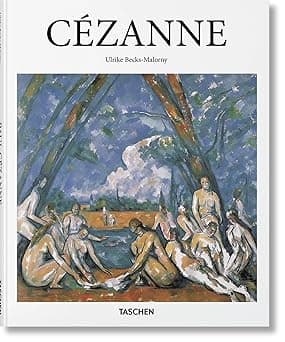 Further reading: Cézanne (Basic Art) — Ulrike Becks-Malorny
Palette
The colours reconstructed for this artist, with the reasoning behind each.
Pigments used: Ultramarine · Cobalt blue · Lead white · Cadmium yellow · Viridian · Chrome green · Ochre · Sienna · Bone black · Zinc white · Vermilion
Essays: How colour became a science
Lexicon: Simultaneous Contrast
Also in this era
Working at the same time
Elsewhere in the atlas, in other movements and other media, these were the hands at work during the same years.