Claude Monet
1840–1926French · Impressionism 1860–1890
A critic used the title of one of his paintings as an insult and accidentally named the movement. Monet then spent sixty years pursuing a single problem — what light does to a surface — with a persistence that ended in a room-sized painting of a pond.
Formation
Grew up in Le Havre selling caricatures, and was taken outdoors to paint by Eugène Boudin, who convinced him that work made in front of the subject had a quality studio work did not. He studied briefly in Paris, met Renoir, Sisley and Bazille, and spent the 1860s and 70s in poverty severe enough that he destroyed canvases to keep them from creditors and once attempted suicide. Impression, Sunrise was shown at the independent exhibition of 1874 that the group organised after repeated Salon rejections.
Technique
Painting outdoors, fast, on a white or pale ground, in broken strokes of unmixed colour laid side by side rather than blended. The pale ground is the technical key: it keeps the whole canvas luminous where a traditional dark ground absorbs light. He worked wet-into-wet within a session and often on multiple canvases at once, switching as the light moved — the Rouen Cathedral and Haystack series exist because a subject at nine in the morning and at four in the afternoon is, for his purposes, two different subjects. The late Water Lilies were painted in a purpose-built studio at Giverny, at a scale that abandons the horizon entirely.
The palette
Bright, high-keyed, and famously without black. Lead and zinc white, cobalt and cerulean and later synthetic ultramarine, viridian and emerald green, the cadmiums and chrome yellows, vermilion and the new cobalt violet. He built shadows from the complementary of the light rather than by darkening — a shadow on snow is blue and violet, not grey — which is the observational claim at the centre of Impressionism. Cataracts in his last years shifted his colour perception markedly toward red and yellow, and he had surgery in 1923 and repainted work he had made while affected.
Legacy
The series principle — one subject, many canvases, the difference between them being the whole content — is one of the most consequential ideas in modern art and runs directly to Cézanne's Sainte-Victoire and to twentieth-century serial work. The late Water Lilies were largely ignored at his death and were then claimed by the Abstract Expressionists in the 1950s as a precursor.
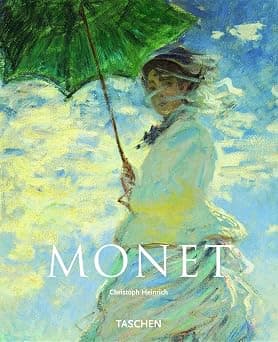 Further reading: Monet (Taschen Basic Art) — Christoph Heinrich
Palette
The colours reconstructed for this artist, with the reasoning behind each.
Pigments used: Cobalt blue · Cerulean blue · Lead white · Vermilion · Chrome yellow · Cadmium yellow · Ultramarine · Cobalt violet · Viridian · Chrome green · Lamp black
Essays: How colour became a science
Lexicon: Hue · Tint, Shade, Tone · Saturation / Chroma · Complementary · Analogous · Simultaneous Contrast
Working at the same time
Elsewhere in the atlas, in other movements and other media, these were the hands at work during the same years.