James Abbott McNeill Whistler
1834–1903American · 19th-Century Realism & Tonalism 1850–1910
He titled his paintings as if they were music — nocturnes, symphonies, arrangements — sued a critic for saying he flung a pot of paint in the public's face, won a farthing in damages, and went bankrupt paying the costs.
Formation
American, raised partly in Saint Petersburg where his father was building a railway, briefly at West Point, and then in Paris from 1855 among the Realists around Courbet. He settled in London in 1859 and spent his career between the two cities. Japanese prints reached Paris in the 1860s and reorganised his sense of composition permanently: flat pattern, asymmetry, cropped forms, empty space carrying weight.
Technique
Extreme thinness and extreme preparation. Whistler thinned his paint with turpentine and medium into what he called "sauce", a liquid so fluid it ran, and applied it in transparent films to a canvas laid flat on the floor — the Nocturnes are built from a few of these veils, with the whole tonal structure resolved in advance and executed rapidly from memory. He observed the river at night and painted it the next day in the studio, on the grounds that memory eliminates the inessential. Failed attempts were destroyed, and he destroyed a great many.
The palette
Tonal rather than chromatic, and organised like a musical key. A Nocturne may contain almost nothing but blue-grey and black, with a single spark of orange for a firework or a lamp; the Symphony in White pictures are exercises in distinguishing a dozen whites from each other. He mixed a full palette of pre-blended tones before starting, so that painting became a matter of placing prepared values rather than mixing while working. Colour is never local — an object is whatever the atmosphere makes it.
Legacy
Art for art's sake found in him its most effective advocate: the insistence that a painting is an arrangement of form and colour first and a depiction second is the argument that opens toward abstraction. The Ruskin libel trial is the most famous public confrontation between an artist and a critic, and his Peacock Room, made for a patron who then refused to pay the full fee, is one of the great interiors of the century.
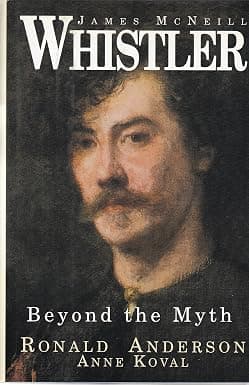 Further reading: James McNeill Whistler: Beyond the Myth — Ronald Anderson and Anne Koval
Palette
The colours reconstructed for this artist, with the reasoning behind each.
Pigments used: Prussian blue · Lamp black · Cadmium yellow · Gold leaf · Lead white · Vermilion · Ochre · Bone black
Lexicon: Analogous
Also in this era
Working at the same time
Elsewhere in the atlas, in other movements and other media, these were the hands at work during the same years.