Paul Gauguin
1848–1903French · Post-Impressionism 1886–1910
He was a stockbroker until he was thirty-five, abandoned a wife and five children to paint, and spent his last decade in the Pacific producing work that is both magnificent and inseparable from the colonial arrangement that made it possible.
Formation
A successful Paris stockbroker and Sunday painter who collected Impressionists, he lost his position in the market crash of 1882 and turned to painting full time. He worked in Brittany at Pont-Aven, where he developed a flat, outlined, non-naturalistic style with Émile Bernard, spent the famously disastrous nine weeks with Van Gogh in Arles in 1888, and left for Tahiti in 1891. He died in the Marquesas in 1903, in poor health and in conflict with the colonial administration.
Technique
Flatness, outline and invented colour. Gauguin rejected the Impressionist project of recording an optical sensation and built pictures from memory and imagination in broad areas of unmodulated colour bounded by dark contours — the method he and Bernard called cloisonnisme, after the enamelwork it resembles. He worked on coarse, absorbent canvas with matte, thin paint, avoiding gloss and modelling, and he took the compositional logic from Japanese prints, medieval stained glass and Breton folk carving. He was also a serious woodcarver and printmaker, and his rough-cut woodblocks were as influential as the paintings.
The palette
Arbitrary by design. He said that if a tree looks blue to the painter it should be painted blue, and the Tahitian canvases put pink sand against orange ground and violet shadow with no observational justification at all. Chrome and cadmium yellow, vermilion, viridian and emerald, cobalt and ultramarine, applied flat and at full saturation. The colour is symbolic and decorative rather than descriptive, which is the pivot from Impressionism to everything that treats colour as an independent means.
Legacy
The Fauves, the Nabis, German Expressionism and Picasso all take from him. His reputation now carries an unavoidable second question: the writings and the relationships with Tahitian girls as young as thirteen, and the way the paintings market an exoticised Pacific to a European audience, are part of the record and are increasingly central to how the work is exhibited and discussed.
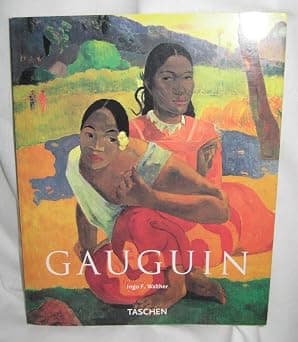 Further reading: Gauguin (Taschen Basic Art) — Ingo F. Walther
Palette
The colours reconstructed for this artist, with the reasoning behind each.
Pigments used: Cadmium yellow · Ochre · Sienna · Vermilion · Cadmium red · Emerald green · Viridian · Chrome green · Ultramarine · Prussian blue · Chrome yellow · Madder and the red lakes · Cobalt violet
Also in this era
Working at the same time
Elsewhere in the atlas, in other movements and other media, these were the hands at work during the same years.