Toulouse-Lautrec
1864–1901French · Post-Impressionism 1886–1910
An aristocrat with a genetic bone disorder who made his life in the dance halls and brothels of Montmartre, and who did more than anyone to turn the printed poster into an art form.
Formation
Born into one of the oldest noble families in France, the son of first cousins; a bone condition, probably a rare genetic disorder, left his legs stunted after childhood fractures. He trained in Paris under Bonnat and Cormon, and settled in Montmartre in the 1880s among the cabarets. He was a regular and eventually a resident in the brothels he painted, drank heavily, and died at thirty-six.
Technique
Drawing, above everything, and an unusual paint method: peinture à l'essence, oil thinned heavily with turpentine and applied to unprimed cardboard, which absorbs the oil and leaves a matte, dry, chalky surface closer to pastel than to conventional oil. It suited him because it is fast and it lets the board's warm tone function as a mid-value. He drew with the brush in long confident contours, left large areas bare, and worked from rapid sketches made on the spot. In lithography he mastered crachis — spattered ink — and printed in flat colour areas with the drawing carried entirely by line.
The palette
Artificial light, which was new. Lautrec is the first major painter of gaslight and early electric light, and his colour reflects it: acid greens, sulphurous yellows, harsh whites on faces, with the flesh often given an unhealthy green or violet cast that is an accurate report of how people look under stage lighting. In the posters the palette reduces to three or four flat colours for printing reasons, and that constraint produced the most economical designs of the period.
Legacy
The modern poster begins with him: flat colour, bold contour, integrated lettering, an image legible at speed from across a street. Graphic design, advertising and printmaking all descend from those sheets. His paintings of brothel interiors are also, unusually for the period, made from inside the situation and without moralising, which is why they have aged better than most nineteenth-century treatments of the subject.
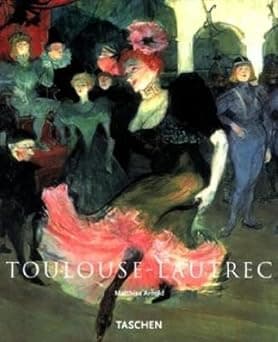 Further reading: Toulouse-Lautrec (Basic Art) — Matthias Arnold
Palette
The colours reconstructed for this artist, with the reasoning behind each.
Pigments used: Viridian · Chrome green · Vermilion · Cadmium red · Bone black · Chrome yellow · Cadmium yellow · Ochre · Lead white
Also in this era
Working at the same time
Elsewhere in the atlas, in other movements and other media, these were the hands at work during the same years.