Gustave Moreau
1826–1898French · Symbolism 1880–1910
He painted jewelled mythological scenes that Huysmans made famous in a novel, then spent his last years teaching Matisse and Rouault to disregard everything he had done. He left his house and its fourteen thousand works to the state as a museum.
Gustave Moreau's color palette
The colours reconstructed for this artist, with the reasoning behind each. Each swatch is an interpretation of the materials behind it, not a sample taken from a single work. How the palettes are made
Sapphire vision
Deep jewel blue — literally encrusted like a precious stone.
Material: Ultramarine, cobalt blue, thick impasto
RGB(26, 58, 138)
Gilded myth
Gold-toned flesh of mythological figures.
Material: Gold paint, yellow ochre, lead-tin yellow
RGB(200, 164, 74)
Salomé's blood
Dark blood-red of decapitation scenes.
Material: Crimson lake, vermilion, burnt sienna
RGB(138, 26, 42)
Sphinx emerald
Deep jewel-green of mythical landscapes.
Material: Viridian, emerald green, malachite
RGB(42, 90, 58)
Opal violet
Iridescent violet of mystical atmosphere.
Material: Cobalt violet, ultramarine, crimson lake
RGB(106, 58, 138)
Encrusted pearl
Thick impasto white — literal jeweled surface.
Material: Lead white, zinc white, palette knife texture
RGB(220, 208, 192)
Pigments used: Ultramarine · Cobalt blue · Lead-tin yellow · Ochre · Gold leaf · Vermilion · Madder and the red lakes · Sienna · Malachite · Emerald green · Viridian · Cobalt violet · Lead white · Zinc white
Formation
Trained in the academic tradition in Paris and spent two years in Italy copying — Mantegna, Carpaccio, the Renaissance masters — which supplied the archaeological detail his pictures are dense with. He exhibited at the Salon from the 1860s and had a substantial success, then withdrew from public exhibition for nearly twenty years and worked in private. In 1892 he became a professor at the École des Beaux-Arts, where he turned out to be an unusually liberal teacher.
Technique
Encrusted and jewel-like. Moreau built surfaces in dense layers of paint, glaze and impasto, sometimes scratching into the surface and applying paint with the palette knife to create an effect closer to enamel, mosaic or precious metalwork than to conventional oil painting. Many pictures were reworked over years and left unresolved. His watercolours and the extraordinary unfinished oil sketches — loose, abstract fields of colour with no subject at all — look nothing like the finished works and are what most interests modern viewers.
The palette
Deep, saturated and metallic. Lakes and vermilion, ultramarine, gold, viridian and emerald, applied in small intense areas so that the whole surface glitters rather than resolving into broad tonal masses. The intention is decorative and hieratic: colour as encrustation. In the unfinished works the same palette appears as pure floating colour without descriptive purpose, which is why they were later read as proto-abstract.
Legacy
Huysmans's À rebours made his Salome the emblem of Decadent taste and secured his fame beyond the art world. As a teacher he was decisive: he told students to look at the street and to follow their own temperament, and Matisse, Marquet and Rouault came out of his studio. The Musée Gustave Moreau, his own house, preserved the studio intact and is one of the strangest and most complete artist museums anywhere.
By Pigmentoria · Published · Palette: interpretive reconstruction
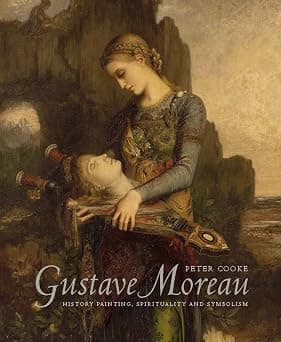 Further reading: Gustave Moreau: History Painting, Spirituality, and Symbolism — Peter Cooke
As an Amazon Associate, Pigmentoria earns from qualifying purchases. This page may contain affiliate links.
Also in this era
Working at the same time
Elsewhere in the atlas, in other movements and other media, these were the hands at work during the same years.