Gustave Courbet
1819–1877French · 19th-Century Realism & Tonalism 1850–1910
"Show me an angel and I will paint one." Courbet made ordinary people the size of history painting, called himself a Realist before anyone else used the word as a banner, and was eventually bankrupted by a toppled column.
Formation
From Ornans in the Franche-Comté, largely self-taught by copying in the Louvre — Spanish and Dutch painting above all, Velázquez, Zurbarán, Rembrandt. A Burial at Ornans, exhibited in 1850, showed the funeral of an unimportant provincial man on a canvas over six metres wide, at a scale reserved for kings and battles, and the critical outrage was about that scale as much as the subject. In 1855, rejected by the Exposition Universelle, he built his own pavilion outside and charged admission, which is the first independent one-man show in the modern sense.
Technique
Palette knife, thick paint, and dark grounds. Courbet often laid in an entire canvas in dark tones and then worked upward with a knife, dragging opaque colour across the surface so the paint has a physical, geological presence — rock, snow and foliage are built as matter rather than described. He painted quickly and directly, with little glazing, and used the knife not as a shortcut but because it produces a broken, granular edge that reads as texture at a distance. His landscapes and wave paintings are among the most physically present surfaces of the century.
The palette
Dark, earthy and grounded in the Spanish tradition. Earths, bone black, lead white, with green earth and viridian in the landscapes and restrained use of the brighter new pigments. He built light out of a dark ground rather than starting light, which puts him technically closer to the seventeenth century than to his Impressionist successors — Manet and the younger painters would eventually abandon exactly this in favour of a light ground.
Legacy
Realism as a self-conscious programme starts with him, and the independent exhibition he organised in 1855 is the direct ancestor of the Salon des Refusés and every artist-run show since. He served on the Paris Commune, was held responsible for the destruction of the Vendôme Column, was imprisoned and then billed for its reconstruction, and died in exile in Switzerland the year before the first payment was due.
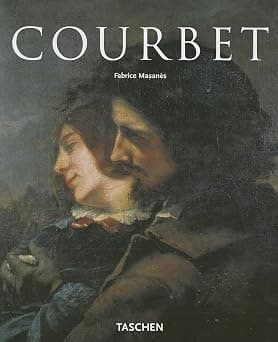 Further reading: Courbet (Taschen Basic Art) — Fabrice Masanès
Palette
The colours reconstructed for this artist, with the reasoning behind each.
Pigments used: Umber · Lead white · Lamp black · Bitumen · Bone black · Vermilion · Ochre · Viridian · Prussian blue · Sienna
Also in this era
Working at the same time
Elsewhere in the atlas, in other movements and other media, these were the hands at work during the same years.