Jean-Auguste-Dominique Ingres
1780–1867French · Neoclassicism 1760–1830
He considered himself a history painter and resented the portraits that made his living, which is unfortunate, because the portraits are the masterpieces. He also drew backs with more vertebrae than anatomy permits, and did it on purpose.
Formation
A student of David, Prix de Rome in 1801, and resident in Italy for eighteen years — long enough that Paris largely forgot him. His early submissions to the Salon were savaged for their strangeness: flat, linear, archaic, with figures that critics compared to Gothic painting, which at the time was an insult. He returned to France in 1824 and became, within a decade, the establishment figure against whom Romanticism defined itself, eventually directing the French Academy in Rome.
Technique
A line of extraordinary refinement laid over a smooth, invisible paint surface. Ingres drew obsessively — the graphite portrait drawings are among the finest ever made — and then transferred that authority into paint with almost no visible handling. His flesh is polished to the point of appearing lit from inside, achieved with fine blending and thin layers over a light ground. The famous distortions are deliberate and calculated: the Grande Odalisque's elongated spine, the boneless arm in Madame Moitessier, the neck of the Comtesse d'Haussonville. He was told repeatedly that the anatomy was wrong and continued, because the contour mattered more than the skeleton.
The palette
Cool, clean and completely disciplined. Enamel-like flesh, blues and satiny whites, a strong local red or gold placed where the composition needs weight. The colours are laid within contours and never allowed to bleed, and the effect is closer to a Persian miniature or an early Italian panel than to anything Romantic. He said drawing was the probity of art, which is a moral claim about a technical question and tells you exactly where he stood.
Legacy
The Ingres-versus-Delacroix opposition organised French art criticism for decades and was always something of a caricature, but it stuck. His real afterlife is stranger: Degas, Renoir, Matisse and Picasso all studied him closely, and the deliberate distortion of the body in service of design is one of the direct routes from Neoclassicism into modernism.
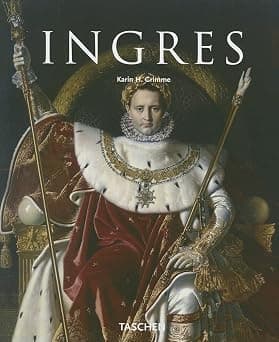 Further reading: Ingres (Taschen Basic Art) — Karin H. Grimme
Palette
The colours reconstructed for this artist, with the reasoning behind each.
Pigments used: Vermilion · Ochre · Lead white · Ultramarine · Cobalt blue · Madder and the red lakes · Lead-tin yellow · Gold leaf · Bone black
Also in this era
Working at the same time
Elsewhere in the atlas, in other movements and other media, these were the hands at work during the same years.