J.M.W. Turner
1775–1851British · Romanticism 1780–1850
He exhibited at the Royal Academy at fifteen, became its youngest full member, and spent the second half of his career painting things critics said looked like soapsuds and whitewash. He left three hundred paintings and nineteen thousand works on paper to the nation.
Formation
A barber's son from Covent Garden with almost no formal education, admitted to the Royal Academy schools at fourteen. He began as a topographical watercolourist, producing accurate architectural views for engraving, and that commercial training in watercolour is the foundation of everything: the transparency, the wash, the light left in the paper. He travelled compulsively — the Alps, Venice, the Rhine — filling sketchbooks that were still being catalogued a century after his death.
Technique
He brought watercolour method into oil, which nobody had done at that scale. He worked on brilliant white grounds and built up in thin, translucent scumbles and glazes so that light returns through the paint, then struck opaque highlights into it. On Varnishing Days at the Academy — when artists could retouch hung work — he was known to arrive with a nearly blank canvas and finish the entire painting in public over three days, which was partly performance and partly method. In the late work the subject dissolves into pure atmospheric colour, and contemporaries could not tell whether the pictures were finished.
The palette
He adopted every new pigment as it appeared, with sometimes disastrous results. Chrome yellow, emerald green, the new cobalt, iodine scarlet — his palette is a catalogue of nineteenth-century chemistry, and a good deal of it was fugitive. Several major works have faded or discoloured significantly because he was more interested in the effect than in permanence, and he was warned about it. The late paintings are organised around a warm-cool axis, a yellow-white sun against blue-grey atmosphere, with the light source usually placed at the vanishing point so the whole space empties into it.
Legacy
Ruskin devoted much of Modern Painters to defending him, the Impressionists studied him during their London exile in 1870–71, and the late unfinished canvases were adopted retrospectively by twentieth-century abstraction — a reading that is anachronistic but keeps being made because the pictures invite it. The Turner Bequest at Tate is the largest body of work by a single artist held anywhere.
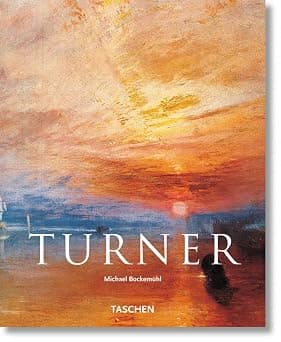 Further reading: Turner (Taschen Basic Art) — Michael Bockemühl
Palette
The colours reconstructed for this artist, with the reasoning behind each.
Pigments used: Chrome yellow · Prussian blue · Lead white · Lamp black · Zinc white · Vermilion · Red lead · Green earth · Ochre
Essays: Why old paintings look brown
Lexicon: Fugitive
Also in this era
Working at the same time
Elsewhere in the atlas, in other movements and other media, these were the hands at work during the same years.