Francisco Goya
1746–1828Spanish · Romanticism 1780–1850
He was First Court Painter to a Spanish king and he painted the Black Paintings directly onto the walls of his own house, for nobody. Goya is two artists occupying one biography, and the second one has no precedent at all.
Formation
From Aragón, trained provincially, failed twice at the Academy in Madrid, and worked his way up through tapestry cartoons for the royal factory — cheerful scenes of picnics and parasols that gave him a mastery of light and a thorough understanding of what the court wanted. He became court painter in 1786 and First Court Painter in 1799. An illness in 1793 left him permanently deaf, and the work darkens from that point; the Peninsular War and the French occupation supplied the rest.
Technique
Increasingly free, increasingly direct, and by the end almost violent. The early court portraits are conventionally built; the late work is applied with brushes, rags, palette knives and probably his fingers, on dark grounds, with the paint scrubbed and dragged rather than laid. The Black Paintings were executed in oil directly onto the plaster walls of the Quinta del Sordo — a technically doomed decision, since oil on plaster does not adhere well, and they were transferred to canvas decades later in an operation that damaged them considerably. In printmaking he was equally inventive, combining etching with aquatint to get broad tonal fields, which is what gives the Caprichos and the Disasters of War their smothering darkness.
The palette
A narrowing. The tapestry cartoons are bright and full; the late work reduces to black, white, ochre, red earth and very little else. That reduction is expressive rather than economic — he had access to anything he wanted — and the near-monochrome of Saturn or the Dog is a deliberate refusal of colour. The Third of May keeps one violent yellow-white lantern and one red, and everything else is dark; the entire painting is organised so those two notes carry it.
Legacy
Manet took the handling and the black, the Impressionists took the freedom, and the Expressionists took the subject matter. The Disasters of War established the idea that an artist can bear witness against power, and the print series has been reworked and quoted continuously since. He died in Bordeaux, in voluntary exile.
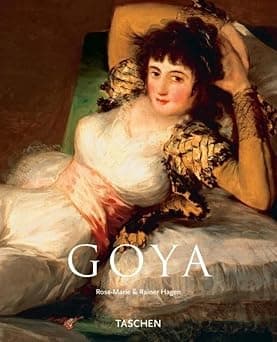 Further reading: Goya (Taschen Basic Art) — Rose-Marie Hagen, Rainer Hagen
Palette
The colours reconstructed for this artist, with the reasoning behind each.
Pigments used: Bitumen · Bone black · Ochre · Sienna · Lead white · Umber · Lamp black
Also in this era
Working at the same time
Elsewhere in the atlas, in other movements and other media, these were the hands at work during the same years.