Eugène Delacroix
1798–1863French · Romanticism 1780–1850
The champion of colour in a century that had been taught to believe in line. His journals are one of the great documents of how a painter thinks, and Signac later wrote an entire book arguing that everything the Neo-Impressionists did began with him.
Formation
Trained under Pierre-Narcisse Guérin alongside Géricault, whose Raft of the Medusa he posed for and whose ambition he inherited. The Massacre at Chios in 1824 established him as the leader of the Romantic camp, whether or not he wanted the position. The decisive event was a journey to Morocco and Algeria in 1832 as part of a diplomatic mission: he filled seven sketchbooks, and the light and colour he saw there fed the work for the remaining thirty years.
Technique
Colour applied in distinct, visible touches that mix in the eye rather than on the palette. Delacroix understood that a shadow contains the complementary of the light, and he laid green into red flesh and violet into yellow ground, using small hatched strokes so that the eye combines them at a distance. He worked on light or mid-tone grounds, kept the surface active and unblended, and finished with glazes and scumbles that pull the whole together. The scale of his public commissions — the Palais Bourbon, Saint-Sulpice — forced a system efficient enough to cover walls.
The palette
Enormous and consciously theorised. He studied Chevreul's law of simultaneous contrast, kept notes on colour relationships, and constructed palettes in advance for particular pictures. Emerald green, cobalt, chrome yellow, vermilion, the lakes, ultramarine — he used the new nineteenth-century chemistry fully. His principle was that no colour exists alone: a tone is determined by what is beside it, and a grey made of complementaries is alive where a grey made of black and white is dead.
Legacy
Van Gogh copied him, Cézanne revered him, Seurat and Signac built Neo-Impressionism explicitly on his colour theory, and Matisse traced a direct line back to him. The Ingres-Delacroix argument settled decisively in his favour, in the sense that essentially all subsequent painting is on the colour side of it.
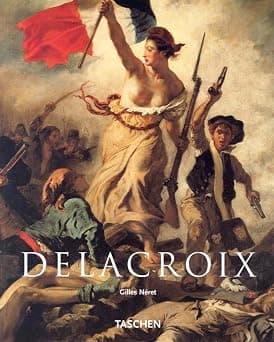 Further reading: Delacroix (Taschen Basic Art) — Gilles Néret
Palette
The colours reconstructed for this artist, with the reasoning behind each.
Pigments used: Vermilion · Red lead · Ultramarine · Cobalt blue · Green earth · Viridian · Ochre · Lead white · Madder and the red lakes · Naples yellow · Chrome yellow
Essays: How colour became a science
Lexicon: Complementary
Also in this era
Working at the same time
Elsewhere in the atlas, in other movements and other media, these were the hands at work during the same years.