Caspar David Friedrich
1774–1840German · Romanticism 1780–1850
He painted the back of a man's head more famously than most painters have painted a face. Friedrich put a figure between us and the landscape and made the landscape a religious subject without any religion visibly in it.
Formation
From Greifswald on the Baltic, trained in Copenhagen, and settled in Dresden in 1798, where he remained. He lost his mother, two sisters and a brother in childhood — the brother drowned in an ice-skating accident, possibly while rescuing him — and biographers have leaned on that heavily. He worked in near-isolation from the art centres, was admired early, appointed to the Dresden Academy, and then fell out of fashion completely; he died half-forgotten and partly paralysed by a stroke.
Technique
Meticulous, cold and entirely studio-made. Friedrich drew precise studies outdoors and then constructed the paintings indoors from those fragments, assembling landscapes that do not exist — a Baltic rock formation with Bohemian mountains behind it. He worked in thin, smooth, carefully graded layers with almost no visible brushwork, building skies as continuous tonal transitions. The compositions are governed by a stark symmetry and by large empty areas, and the technical restraint is essential: any visible handling would break the stillness.
The palette
Cold and reduced, organised around a single light event. A Friedrich sky is usually a slow gradation from a warm horizon to a cold zenith, achieved by very fine blending, and the foreground is held in silhouette against it. Earths, blues, and a violet-grey range that he used more than most of his contemporaries. He often reserves the only warm note for the source of light — a rising sun, a moon, a distant fire — so the eye is drawn to it exactly as the figure in the picture is drawn to it.
Legacy
Forgotten for most of the nineteenth century and revived around 1900, then compromised by National Socialist appropriation of the German-landscape imagery in the 1930s, which delayed his international rehabilitation by decades. The Rückenfigur — the figure seen from behind, standing in for the viewer — is now one of the most quoted devices in visual culture, from Romantic painting to film to advertising.
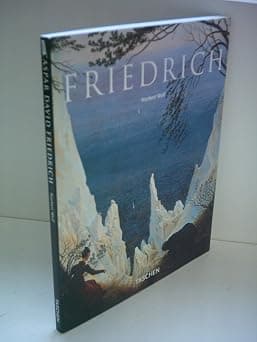 Further reading: Caspar David Friedrich (Taschen Basic Art) — Norbert Wolf
Palette
The colours reconstructed for this artist, with the reasoning behind each.
Pigments used: Umber · Lead white · Lamp black · Bone black · Naples yellow · Chrome yellow · Prussian blue · Green earth · Ochre · Sienna
Also in this era
Working at the same time
Elsewhere in the atlas, in other movements and other media, these were the hands at work during the same years.