Egon Schiele
1890–1918Austrian · Vienna Secession & Expressionism 1897–1920
He drew the human body with a line that nobody has matched for nervous exactitude, spent twenty-four days in jail over his drawings, and died at twenty-eight in the influenza pandemic, three days after his pregnant wife.
Formation
Admitted to the Vienna Academy at sixteen and left after three years, finding it stifling; Klimt took an interest in him, exchanged drawings with him and introduced him to patrons, which effectively launched the career. He moved to a small town outside Vienna to work and was arrested there in 1912 on charges involving a minor, the serious ones dismissed; he was convicted of exhibiting an erotic drawing where children could see it, and a judge burned one of his drawings in the courtroom.
Technique
Line first, and the line does not hesitate. Schiele drew directly in pencil, chalk or ink, without preliminary construction, establishing a contour in a single continuous movement — the drawings show almost no correction, which at that level of distortion is remarkable. Colour is then applied in flat washes of gouache and watercolour inside or deliberately outside the line, often leaving the paper bare so the figure floats without setting or ground. In oil he worked more thickly, with a scratchy, dragged surface and a similar refusal of environment. Bodies are shown from above, cropped, twisted, with hands and joints exaggerated.
The palette
Bruised and deliberately unhealthy. Ochres, umbers, viridian, alizarin and vermilion, with greens and violets pushed into the flesh so that skin reads as damaged or feverish. He habitually gives a body a green half-tone and a red-orange highlight at knuckles, knees and eyelids, which is anatomically plausible and emotionally extreme at once. Backgrounds are usually blank, so nothing dilutes the figure.
Legacy
The unflinching treatment of the body — sexual, awkward, mortal, self-observed — set a precedent that runs directly to Bacon, Freud and a great deal of later figurative painting. His work was little known outside Austria until the 1960s and is now among the most recognisable of the century. The 1912 arrest and its documentation remain a standard case study in the history of art and censorship.
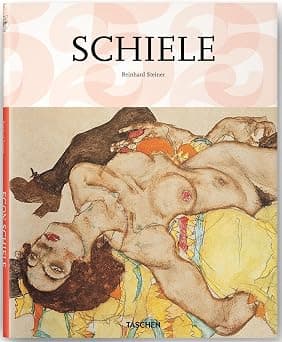 Further reading: Schiele (Taschen Basic Art) — Reinhard Steiner
Palette
The colours reconstructed for this artist, with the reasoning behind each.
Pigments used: Alizarin crimson · Cobalt violet · Vermilion · Cadmium yellow · Ochre · Umber · Sienna · Cadmium red
Also in this era
Working at the same time
Elsewhere in the atlas, in other movements and other media, these were the hands at work during the same years.