José Clemente Orozco
1883–1949Mexican · Mexican Muralism 1920–1960
The muralist who refused the optimism. Where Rivera painted a redeemed history, Orozco painted fire, mobs and the failure of ideologies, and he did it with one hand — he lost the other in an accident at eighteen.
Formation
Studied agriculture and architectural drawing before painting, and lost his left hand and damaged his sight in a gunpowder explosion. He worked as a newspaper caricaturist during the Revolution, which he witnessed directly and which left him without illusions about it — the difference between his murals and Rivera's is largely the difference between having seen the violence and having theorised the outcome. He spent 1927 to 1934 in the United States, painting major cycles at Pomona College, the New School and Dartmouth.
Technique
Fresco, with the same giornata discipline, but composed for impact rather than instruction. Orozco used violent diagonals, extreme foreshortening and figures that break the picture plane, and he treated the architecture of a building as part of the composition — the Hospicio Cabañas dome in Guadalajara is designed so that the Man of Fire is seen from directly beneath and appears to rise into the cupola. His drawing is heavy and simplified, with thick contours, and he worked faster and more roughly than Rivera.
The palette
Dark, hot and reduced. Black, red earth, ochre, grey and white, with fire as a recurring literal and structural motif. He uses far less colour than Rivera and works instead with strong value contrast, so his walls read as light struggling against a dominant darkness. The restriction gives the cycles a bleakness that is entirely deliberate and that survives the fresco medium's natural tendency toward chalky lightness.
Legacy
Prometheus at Pomona, painted in 1930, was the first modern fresco in the United States, and the Dartmouth cycle is among the most ambitious murals in North America. His refusal of political consolation — he satirised revolutionaries as readily as the church and the wealthy — has made him the muralist whose reputation has aged best among the three great figures, and he was a direct influence on Pollock.
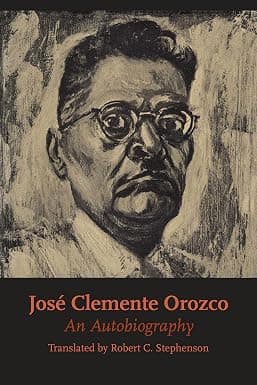 Further reading: José Clemente Orozco: An Autobiography — José Clemente Orozco (trad. Robert C. Stephenson)
Palette
The colours reconstructed for this artist, with the reasoning behind each.
Pigments used: Cadmium red · Cadmium yellow · Lime white · Lamp black · Ochre · Sienna · Umber · Bone black
Also in this era
Working at the same time
Elsewhere in the atlas, in other movements and other media, these were the hands at work during the same years.