Tarsila do Amaral
1886–1973Brazilian · Latin American Modernism 1920–1980
One painting of hers gave a name to a movement and a manifesto: Abaporu, a figure with an enormous foot and a tiny head, prompted the Anthropophagic Manifesto — the argument that Brazil should devour foreign culture and digest it into something of its own.
Formation
From a wealthy coffee-planting family in São Paulo, which allowed her to study in Paris, where she worked under Lhote, Gleizes and Léger and absorbed Cubism and Purism at first hand. She returned to Brazil and, with the writers of the Semana de Arte Moderna generation, particularly Oswald de Andrade, whom she married, set about constructing a modernism that was not an import. A journey through the historic towns of Minas Gerais in 1924 gave her the colour.
Technique
Cubist structure applied to Brazilian subject matter, then progressively simplified. She built compositions from clean geometric volumes — rounded, inflated, smoothly modelled forms with soft gradients and no visible brushwork — set in flattened tropical landscapes with schematic plants and animals. The surface is deliberately smooth and impersonal, closer to Léger and to poster design than to Expressionist handling, and the drawing is precise. The later social-realist works of the 1930s are flatter and more angular.
The palette
Taken directly from rural Brazil and from folk building. She described choosing the colours she had loved as a child and been taught were ugly: caipira pinks, strong blues, vivid greens and yellows, the colours of country houses, festival decoration and the interior. Against Parisian good taste this was a deliberate provocation, and it is the chromatic basis of the Pau-Brasil and Antropofagia phases. Cobalt and cerulean skies, cadmium yellows, viridian, and pinks used at full strength.
Legacy
She is the central figure of Brazilian modernism and Abaporu is the most valuable Brazilian painting ever sold. The anthropophagic idea — that a peripheral culture should consume the metropolis rather than imitate it — remains one of the most influential theoretical positions to come out of Latin American art, quoted well beyond Brazil and well beyond painting.
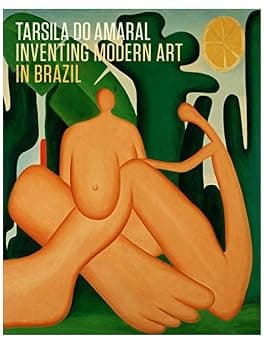 Further reading: Tarsila do Amaral: Inventing Modern Art in Brazil — Stephanie D'Alessandro and Luis Pérez-Oramas (Yale University Press)
Palette
The colours reconstructed for this artist, with the reasoning behind each.
Pigments used: Ultramarine · Cobalt blue · Cadmium yellow · Emerald green · Viridian · Ochre · Sienna · Chrome yellow · Lead white · Chrome green · Lamp black
Also in this era
Working at the same time
Elsewhere in the atlas, in other movements and other media, these were the hands at work during the same years.