de Chirico
1888–1978Italian-Greek · Surrealism & Metaphysical 1911–1950
He painted empty Italian squares with impossible shadows for about a decade, was adopted by the Surrealists as a founding ancestor, and then repudiated the whole thing and spent fifty years painting in a neo-Baroque manner nobody wanted.
Formation
Born in Greece to Italian parents, trained in Athens and Munich, where he absorbed Böcklin and the philosophy of Nietzsche and Schopenhauer — the metaphysical paintings are explicitly philosophical in intent, not dreamlike by accident. The key years are 1910 to 1919, in Florence, Paris and then Ferrara, where he was posted during the war and where the imagery becomes most concentrated.
Technique
Deliberately plain and slightly awkward, which is essential to the effect. De Chirico painted in flat, matte, unmodulated areas with hard outlines and a dry, chalky surface, avoiding any virtuosity that would distract from the image. The disquiet is constructed geometrically: multiple vanishing points that do not agree, shadows cast in contradictory directions, a horizon that sits too high, arcades that recede too fast. Nothing is rendered strangely — the strangeness is in the architecture of the space itself.
The palette
Sour and artificial. Ochre and orange walls against a hard green or blue-black sky, long violet shadows, and a light that reads as very late afternoon in a place where the sun cannot be where the shadows say it is. He often uses a warm ground colour against a cold sky at maximum contrast, so that the square is lit and the sky is nearly night at the same time — an atmospheric impossibility that no viewer questions and everyone feels.
Legacy
Ernst, Magritte, Dalí and Tanguy all took directly from him, and Magritte reportedly wept on seeing a reproduction of The Song of Love. Breton claimed him and then denounced him when he turned classical. He responded to the market for his early work by painting new versions and backdating them, which has left a genuinely difficult attribution problem and a certain scholarly bitterness.
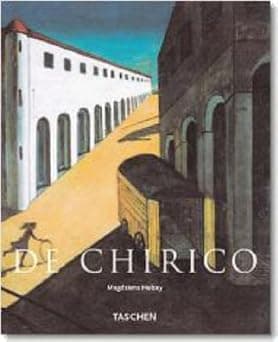 Further reading: Giorgio De Chirico: 1888-1978, the Modern Myth (Taschen Basic Art Series) — Magdalena Holzhey
Palette
The colours reconstructed for this artist, with the reasoning behind each.
Pigments used: Naples yellow · Ochre · Sienna · Viridian · Umber · Lamp black · Cobalt blue · Lead white
Also in this era
Working at the same time
Elsewhere in the atlas, in other movements and other media, these were the hands at work during the same years.