Dalí
1904–1989Spanish · Surrealism & Metaphysical 1911–1950
He had academic technique of a very high order and used it to paint melting watches, which is precisely the point: the more convincingly an impossible thing is rendered, the harder it is to dismiss.
Formation
Trained at the Academy in Madrid, from which he was expelled twice, sharing a residence with Lorca and Buñuel — the collaboration with Buñuel produced Un chien andalou in 1929. He joined the Surrealists in Paris the same year and was expelled by Breton in 1934 over his politics and his commercialism, after which Breton coined the anagram Avida Dollars for him. He spent the war years in the United States and returned to Catalonia, where he built the museum that holds much of the work.
Technique
Nineteenth-century academic method applied to twentieth-century subject matter. Dalí worked on smooth panels and fine canvas with meticulous glazing, tiny brushes and a highly finished surface, deliberately reviving the technique of Vermeer and the Spanish masters he admired. He developed what he called the paranoiac-critical method — inducing a state in which one image can be read as another — and the double images are constructed with real optical precision rather than merely suggested. Later he experimented with stereoscopy, holography and mathematically derived compositions.
The palette
The light of the Empordà, transposed. Clear cerulean and cobalt skies, ochre and burnt sienna plains, long shadows and an extreme depth of field in which a distant cliff is as sharp as a foreground object — the landscape of Cadaqués recurs behind almost everything, which anchors the impossible objects in a real and specific place. Colour is highly saturated and applied with an even, enamel-like finish that removes any sense of the painter's hand.
Legacy
He is the most publicly recognised Surrealist by a wide margin, and the reason the word entered ordinary speech. The self-promotion, the advertising work, the television appearances and the mass-signed blank sheets in the late years did serious damage to his critical standing, and the reassessment that has followed treats the paintings of 1929 to 1939 as the achievement and much of the rest as noise.
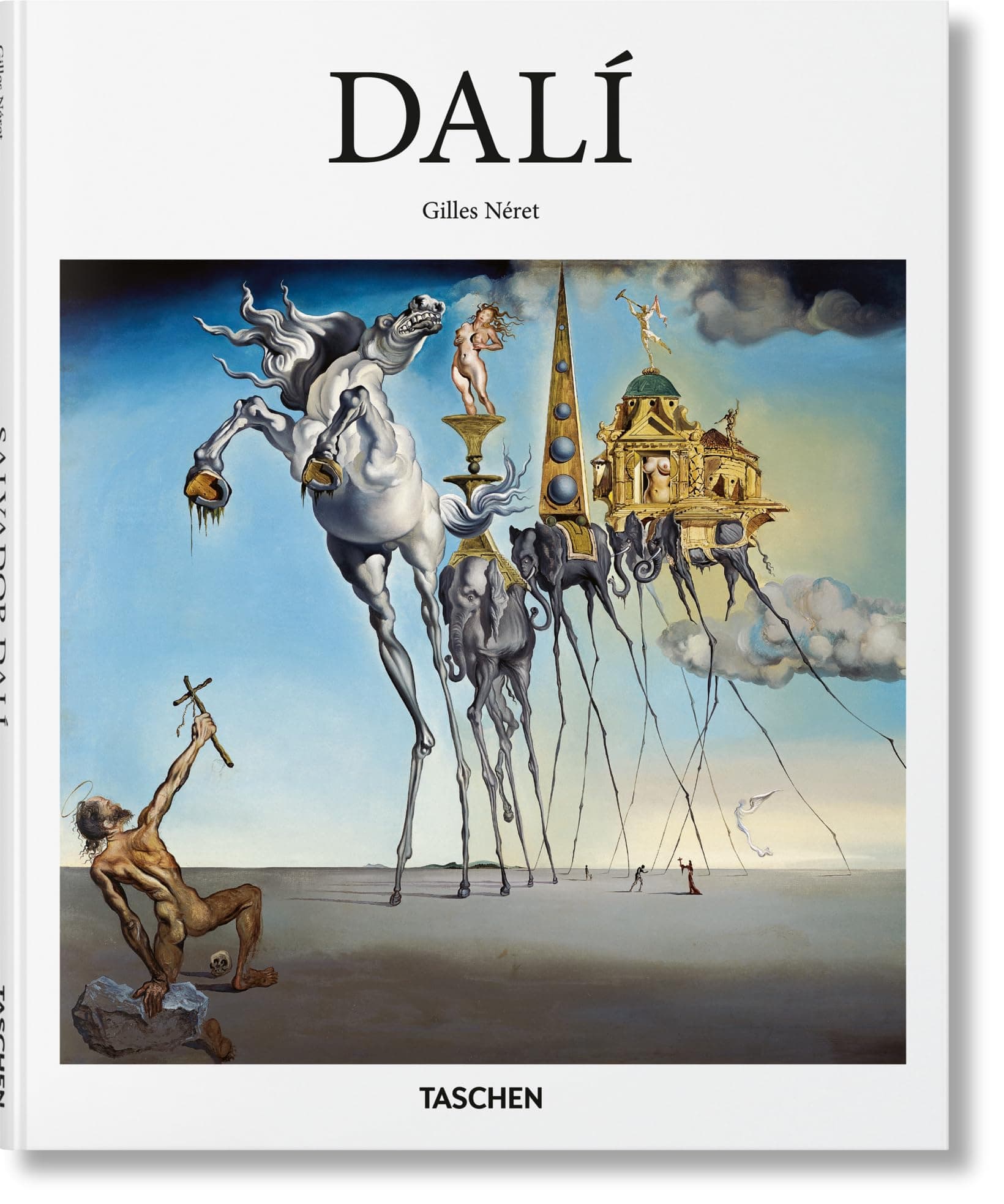 Further reading: Dalí (Basic Art) — Gilles Néret
Palette
The colours reconstructed for this artist, with the reasoning behind each.
Pigments used: Cadmium yellow · Ochre · Sienna · Cobalt blue · Cerulean blue · Lead white · Vermilion · Umber · Lamp black · Zinc white
Also in this era
Working at the same time
Elsewhere in the atlas, in other movements and other media, these were the hands at work during the same years.