Rothko
1903–1970Latvian-American · Abstract Expressionism 1943–1965
He insisted his paintings were not about colour, and objected to being called an abstractionist, a colourist and a Colour Field painter. He said he was interested in tragedy, ecstasy and doom, and that people who wept in front of the pictures had the same religious experience he had while making them.
Formation
Born Markus Rothkowitz in Dvinsk, in the Russian Empire, and emigrated at ten to Portland. He dropped out of Yale, drifted into painting in New York, and spent the 1930s and early 1940s on figurative and then mythological subjects. The signature format — stacked, soft-edged rectangles floating on a coloured field — arrives around 1949 and does not change substantially for the remaining twenty years. He killed himself in his studio in 1970.
Technique
Thin, layered veils on a large scale. Rothko applied many extremely diluted washes of paint, sometimes using egg, glue, damar resin and pigment in unconventional mixtures of his own, building up a field whose depth comes from the number of layers rather than from any thickness. The rectangles have no drawn edge; they are feathered where one veil stops short of another, so the form appears to hover without ever locating itself. He painted large so that the viewer stands close and the picture fills the visual field — he specified that they be hung low and viewed from about forty-five centimetres.
The palette
Luminous and, over time, progressively darker. The early classic works are reds, oranges and yellows of great intensity; the later ones move into maroon, plum, brown and finally black on grey. His mixtures are chemically unstable in places: the Harvard murals faded catastrophically because he used a fugitive red lithol pigment, and the restoration eventually done with projected light rather than paint is one of the most inventive conservation solutions ever attempted. The Seagram murals, made for a restaurant, were withdrawn by him and given to the Tate.
Legacy
The Rothko Chapel in Houston, fourteen near-black paintings in an octagonal non-denominational space, is the fullest statement of the ambition — painting as a place rather than an object. He is also the artist most damaged by reproduction: the pictures depend on scale, on the physical presence of the layers and on standing in front of them, none of which survives a screen.
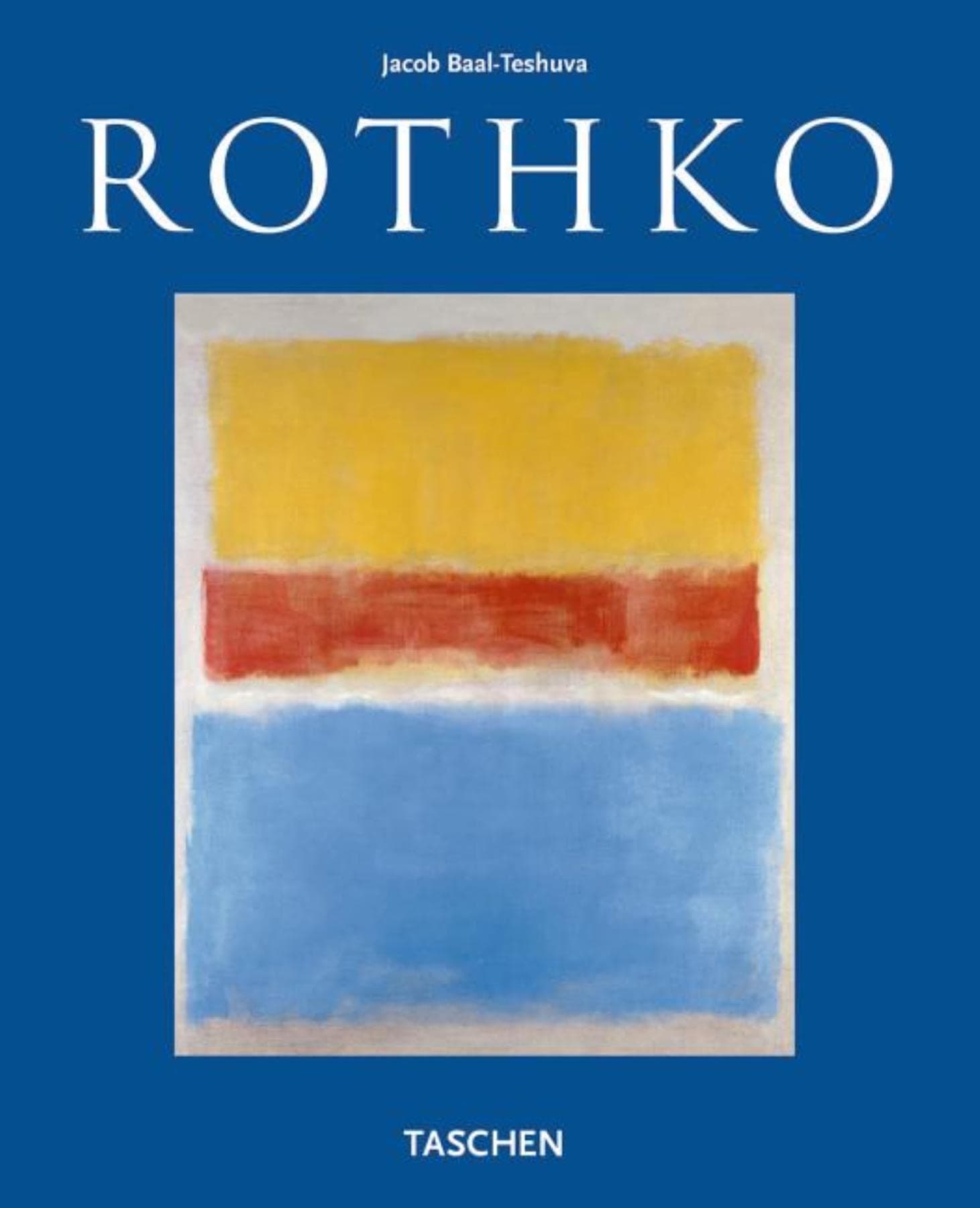 Further reading: Rothko — Jacob Baal-Teshuva
Palette
The colours reconstructed for this artist, with the reasoning behind each.
Pigments used: Cadmium red · Cadmium yellow · Ultramarine · Alizarin crimson · Cobalt blue
Lexicon: Analogous · Simultaneous Contrast
Also in this era
Working at the same time
Elsewhere in the atlas, in other movements and other media, these were the hands at work during the same years.