Franz Kline
1910–1962American · American Modernism 1910–1960
Black bars on white, at architectural scale, made with house-painter's brushes. The story goes that he saw one of his small drawings enlarged in a projector and understood immediately what he should be doing.
Formation
From the Pennsylvania coal region, trained in Boston and London in a traditional figurative curriculum, and worked for years as a competent representational painter of urban scenes and portraits. The change came around 1949–50, in his late thirties, and was abrupt. He was close to de Kooning, and the two of them shared the black-and-white vocabulary in those years to the point where the influence runs both ways.
Technique
Fast, large and physically committed. Kline worked with commercial decorators' brushes, up to twenty centimetres wide, and cheap enamel house paint, on canvases several metres across. He composed from small sketches — frequently made on torn telephone directory pages — which he then enlarged, so the apparent spontaneity is the enlargement of a considered mark rather than an improvisation. Crucially, the white is painted as actively as the black: he worked white over black and black over white repeatedly, so the white is a positive form and not a background.
The palette
Black and white, and the exclusion is the whole proposition. By removing colour he removes everything that might be read as depiction, atmosphere or mood, leaving structure, speed and weight. The blacks are commercial enamel, slightly glossy and dense; the whites are house paint, chalky and opaque. He introduced colour again in the late 1950s, and the results are generally regarded as less resolved, which he seems to have suspected himself.
Legacy
The gestural mark at architectural scale is one of the durable ideas of the New York School, and the black-and-white paintings have been read persistently as calligraphic — a comparison he rejected, pointing out that he was making a structure, not writing. The debt to enlargement and to the accidental discovery of scale is one of the better-documented origin stories in twentieth-century painting.
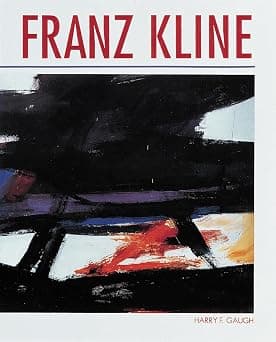 Further reading: Franz Kline — Harry F. Gaugh
Palette
The colours reconstructed for this artist, with the reasoning behind each.
Pigments used: Cadmium yellow
Also in this era
Working at the same time
Elsewhere in the atlas, in other movements and other media, these were the hands at work during the same years.