Frida Kahlo
1907–1954Mexican · Mid-Century Figurative 1930–1980
She painted around fifty-five self-portraits out of roughly two hundred works, and said she painted herself because she was the subject she knew best and was alone most of the time. The Surrealists claimed her; she said she painted her own reality, not dreams.
Formation
Largely self-taught. She was studying medicine when a streetcar accident at eighteen shattered her spine, pelvis and right leg, and she began painting during the long convalescence, with a mirror above the bed. She married Rivera in 1929, and the marriage — two of them, divorce and remarriage, infidelities on both sides — is inseparable from the work. She had a single solo exhibition in Mexico during her lifetime, in 1953, and attended it in a bed carried to the gallery.
Technique
Small, precise and drawn from Mexican vernacular sources. Kahlo painted mostly on modest supports — masonite, metal sheet — in thin, meticulous oil with fine brushes and a flat, bright, unmodelled treatment taken directly from the retablo and ex-voto tradition, the small votive paintings offered in thanks for surviving a disaster. That reference is exact and deliberate: the ex-voto records a catastrophe and a survival, which is the structure of most of her pictures. The finish is smooth, the detail is high, and the scale is intimate.
The palette
Mexican and symbolic. Strong local colour drawn from folk art and from the Tehuana dress she wore deliberately as a political and cultural statement: magenta, cochineal red, cobalt, viridian, cadmium yellow, applied flat and saturated. She wrote about colour in her diary, assigning meanings — green for good warm light, magenta for old blood, yellow for madness, sickness and fear. Blood appears repeatedly as literal red against the flat ground.
Legacy
Her reputation grew enormously from the 1970s onward, driven by feminist scholarship and then by a level of popular circulation that has turned her image into a commodity somewhat independent of the paintings. The work itself is small in quantity, technically conservative and thematically radical: chronic pain, miscarriage, surgery, mixed identity and the female body treated without euphemism at a time when almost nobody was doing it.
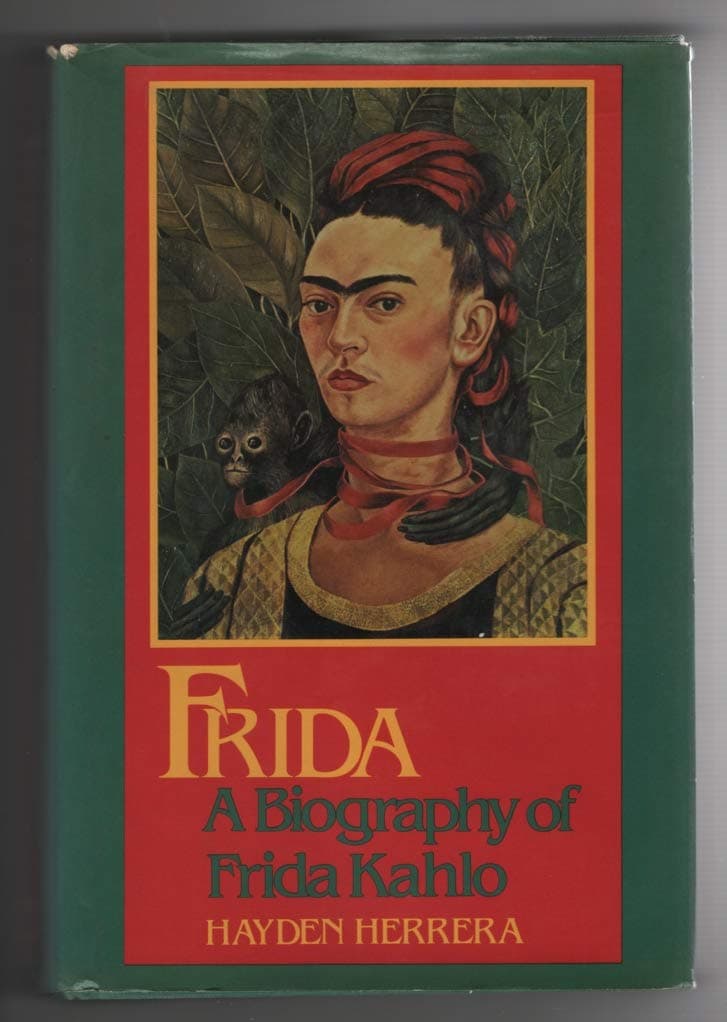 Further reading: Frida: A Biography of Frida Kahlo — Hayden Herrera
Palette
The colours reconstructed for this artist, with the reasoning behind each.
Pigments used: Ultramarine · Cobalt blue · Vermilion · Cadmium red · Alizarin crimson · Lead white · Viridian · Chrome green · Chrome yellow · Cadmium yellow · Ochre · Umber · Sienna
Also in this era
Working at the same time
Elsewhere in the atlas, in other movements and other media, these were the hands at work during the same years.