Magritte
1898–1967Belgian · Surrealism & Metaphysical 1911–1950
He wore a bowler hat, lived in a modest Brussels house, painted in the dining room, and produced the most philosophically precise images in Surrealism. "This is not a pipe" is a sentence about the difference between a thing and its representation, and it is entirely correct.
Formation
Belgian, trained at the Académie Royale in Brussels, and worked as a wallpaper designer and commercial poster artist for years — the flat, legible, sign-like quality of his painting comes directly from that. Seeing a reproduction of de Chirico's The Song of Love around 1923 was the decisive encounter. He spent three years in Paris among the Surrealists in the late 1920s, fell out with Breton, and returned to Belgium, where he remained deliberately unglamorous.
Technique
Plain, competent and self-effacing on purpose. Magritte painted in a flat, even, slightly dry manner with no visible brushwork and no technical display whatsoever, because any flourish would draw attention to the painting as an object and away from the proposition it makes. The images are constructed from ordinary illustrational rendering and depend entirely on displacement: the wrong scale, the wrong context, an object where another should be, day and night in the same picture. He often reused motifs across decades and painted several versions of the same idea.
The palette
Neutral, everyday and deliberately unremarkable. Cool grey-blue skies, mid-green foliage, brown and black clothing, a restricted and slightly muted range that reads as ordinary daylight — which is exactly why the impossible content lands. A picture where the colour was expressive would be a picture about mood; Magritte wants a picture about logic, so the colour stays quiet and describes.
Legacy
His influence outside painting exceeds his influence inside it: advertising, album covers, film and graphic design have quoted him continuously, and the visual paradox as a communication device is largely his. Within art, the interrogation of image and language runs from The Treachery of Images through Conceptualism, and Foucault devoted a short book to that single painting.
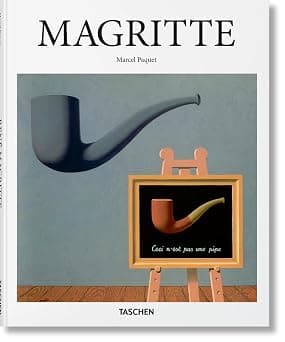 Further reading: Magritte (Basic Art) — Marcel Paquet
Palette
The colours reconstructed for this artist, with the reasoning behind each.
Pigments used: Cobalt blue · Cerulean blue · Lead white · Zinc white · Cadmium yellow · Viridian · Chrome green · Bone black · Vermilion · Cadmium red · Lamp black
Also in this era
Working at the same time
Elsewhere in the atlas, in other movements and other media, these were the hands at work during the same years.