Oskar Kokoschka
1886–1980Austrian · Die Brücke & Der Blaue Reiter 1905–1925
Vienna called him the wild beast. He painted portraits that his sitters often disliked because he claimed to be painting what was inside them, and after his affair with Alma Mahler ended he commissioned a life-size doll of her.
Formation
Trained at the Vienna School of Applied Arts alongside the Secession circle, and made an immediate scandal with a play and a poster in 1909. Klimt supported him. He was severely wounded in the First World War — a bayonet to the lung and a head injury — and taught in Dresden afterwards. Declared degenerate, he left for Prague and then London in 1938, took British citizenship, and lived until 1980, long enough to become an elder statesman of a movement that had ended decades earlier.
Technique
Nervous, scraped and worked wet. Kokoschka built portraits with agitated, scratchy brushwork, often scoring into the wet paint with the brush handle or his fingernails to draw hair, veins and the contours of a hand, so that the surface is visibly disturbed. He used thin, transparent layers over light grounds early on, and became progressively thicker and more turbulent. The late panoramic city views — Prague, London, Jerusalem — are painted from a high viewpoint in loose, swirling strokes that dissolve architecture into weather.
The palette
Restless and mixed on the canvas rather than the palette. Blues and greens dragged through flesh tones, cadmium and vermilion, viridian, with colour applied in adjacent strokes that never quite settle into a local hue — a hand may contain green, violet, orange and pink. The effect is of a body seen under fluctuating light, and it is deliberately unstable: he wanted the portrait to record a psychological state rather than an appearance.
Legacy
The psychological portrait as a genre owes him a great deal, and his handling anticipates a strand of post-war European figuration. His long life gave him an unusual position — an Expressionist who lived to see and publicly reject Abstract Expressionism — and the School of Seeing he founded in Salzburg trained several later generations.
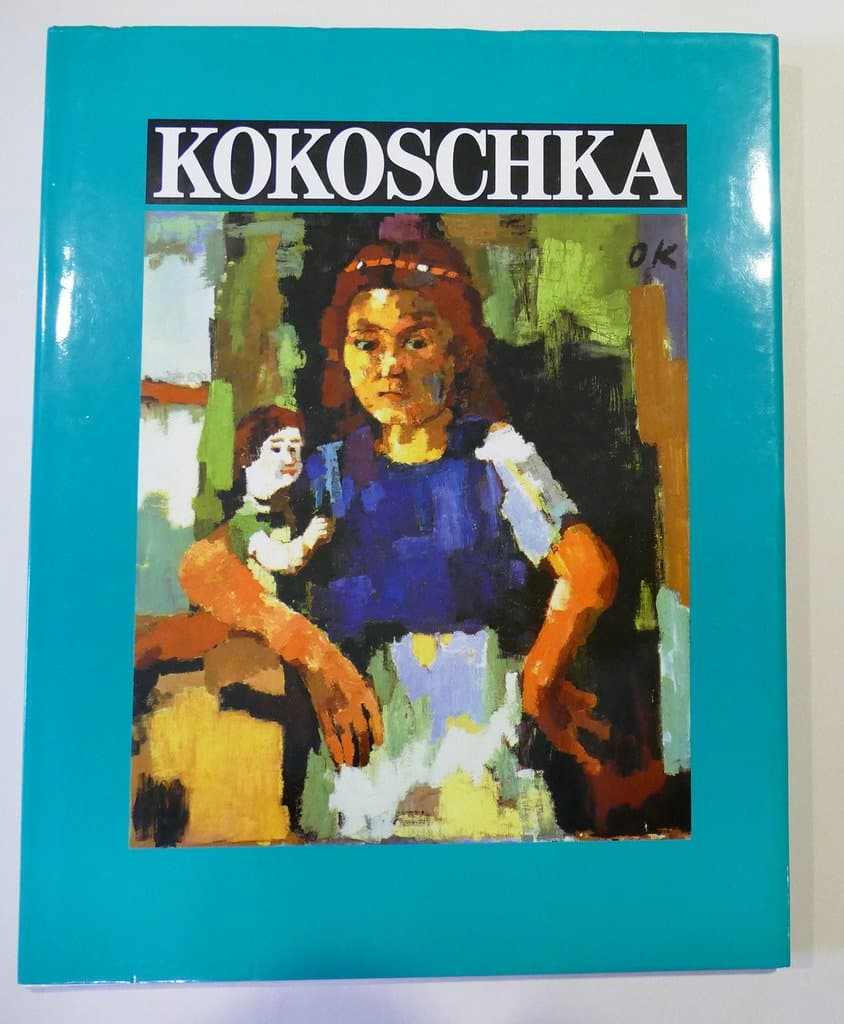 Further reading: Kokoschka (Great Modern Masters) — Jose Maria Faerna
Palette
The colours reconstructed for this artist, with the reasoning behind each.
Pigments used: Vermilion · Cadmium red · Prussian blue · Cobalt blue · Ochre · Lead white · Viridian · Chrome green · Umber · Lamp black
Also in this era
Working at the same time
Elsewhere in the atlas, in other movements and other media, these were the hands at work during the same years.