Pablo Picasso
1881–1973Spanish · Picasso's Chromatic Periods 1901–1973
He produced something like fifty thousand works across seventy-five years, invented or co-invented several of the century's major movements, and changed manner so completely and so often that his career is usually taught as a sequence of separate artists.
Formation
Trained by his father, an art teacher, and academically accomplished as a teenager — the technical facility was never in question, which is why the later dismantling of it is a choice rather than a limitation. He moved between Barcelona and Paris from 1900, settling there in 1904. The Blue and Rose Periods established him; the Demoiselles d'Avignon in 1907, absorbing Cézanne and Iberian and African sculpture, broke the picture surface open and was so disconcerting that he did not exhibit it publicly for years.
Technique
Whatever the problem required. Analytic Cubism, developed with Braque between 1909 and 1912, dismantles the object into faceted planes seen from several positions at once and reduces colour almost to monochrome so that structure is legible. Synthetic Cubism brings colour and collage back — he and Braque glued newspaper, oilcloth and wallpaper onto the surface, which introduces real material into the picture and is arguably the single most consequential technical move of the century. Later he worked in flat outlined areas, in thick expressive paint, in ceramics, in sculpture from scrap, in linocut and lithography, adapting the medium to the idea rather than the reverse.
The palette
Period by period, and used programmatically. The Blue Period is near-monochrome Prussian and cobalt blue with earths; the Rose Period is warm ochre and pink; Analytic Cubism is ochre, grey and umber, deliberately drained so that colour does not interfere with the reading of form; Guernica is black, white and grey, refusing colour entirely for a subject that would drown in it. The late work is loud, flat and saturated. He treated the palette as an instrument to be selected, not a signature to be maintained.
Legacy
Cubism reorganised what a picture could be and everything from abstraction to collage to assemblage follows from it. Guernica, painted for the Spanish Republic's pavilion in 1937 after the bombing of the town, is the most widely recognised political painting ever made and did not return to Spain until 1981. The scale of his output and fame also created the modern figure of the artist as celebrity, with all that has entailed.
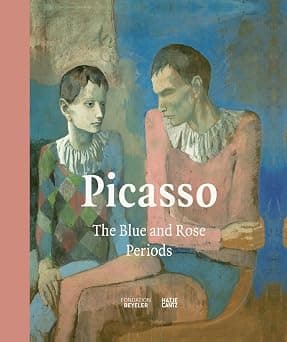 Further reading: Picasso: The Blue and Rose Periods — Marilyn McCully, Raphaël Bouvier, Laurent Le Bon, et al.
Palette
The colours reconstructed for this artist, with the reasoning behind each.
Pigments used: Ultramarine · Prussian blue · Lead white · Vermilion · Ochre · Umber · Sienna · Lamp black · Cadmium red · Zinc white · Titanium white
Working at the same time
Elsewhere in the atlas, in other movements and other media, these were the hands at work during the same years.