Edward Hopper
1882–1967American · Mid-Century Figurative 1930–1980
He painted people in diners, hotel rooms and offices not looking at each other, and became the artist through whom a whole country recognises its own loneliness. He denied that was the subject and said he was just painting sunlight on a wall.
Formation
Trained under Robert Henri in New York, made three trips to Paris between 1906 and 1910 where he was interested in the light and largely ignored Cubism, and then spent nearly twenty years working as a commercial illustrator, which he resented and which sharpened his sense of the telling composition. He did not sell a painting for a decade. Success came in his forties, and the manner then remained essentially unchanged for forty more years.
Technique
Deliberate, slow and constructed. Hopper worked from drawings and from memory rather than from the motif, building a scene in the studio and adjusting the architecture freely — the buildings in his pictures are assembled, not observed. He painted thinly and rather dryly, with a matte, slightly awkward surface and no virtuosity at all; the handling is plain because the drama is entirely in the light and the geometry. His wife Jo posed for every female figure for four decades and kept the ledgers recording each painting.
The palette
Reduced and hard. Ochres, greens, reds and a great deal of white and shadow, with the colour serving temperature rather than description — the point is always the difference between the light side and the shadow side of a wall. He is exact about the specific colour of a particular light: early morning sun on brick is a different colour from late afternoon sun on brick, and the pictures are built on that distinction. Nighthawks organises the entire canvas around the artificial green-white of a fluorescent interior against a dark street, which was a new kind of light in 1942.
Legacy
His compositions have been quoted so extensively in film — by Hitchcock, Wenders, Lynch and many others — that the visual vocabulary of American cinematic loneliness is substantially his. He is also the rare case of a painter whose reputation with the public has never depended on critical fashion, which has swung around him repeatedly without much effect.
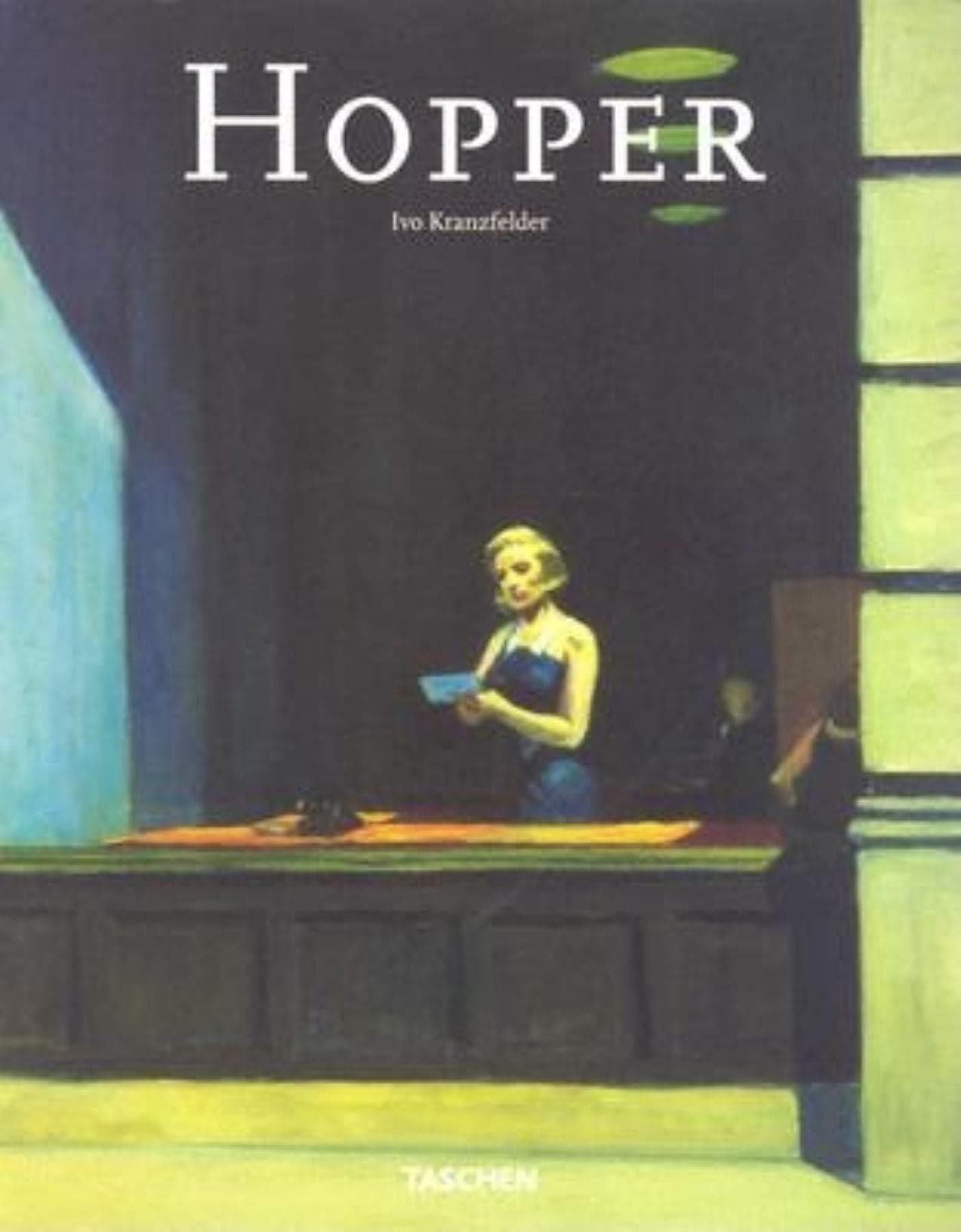 Further reading: Hopper — Ivo Kranzfelder
Palette
The colours reconstructed for this artist, with the reasoning behind each.
Pigments used: Viridian · Chrome green · Lead white · Naples yellow · Cadmium yellow · Ultramarine · Prussian blue · Lamp black · Ochre · Sienna · Cobalt blue
Also in this era
Working at the same time
Elsewhere in the atlas, in other movements and other media, these were the hands at work during the same years.