Diego Rivera
1886–1957Mexican · Mexican Muralism 1920–1960
He spent fourteen years in Europe becoming a competent Cubist, went home, looked at pre-Hispanic art and Italian fresco, and invented a public painting for a country that had just had a revolution.
Formation
Trained in Mexico City, then on a government scholarship in Spain and Paris from 1907, where he worked within Cubism for a decade and knew Picasso and Modigliani. A trip to Italy in 1920 to study Renaissance fresco was the turning point: he returned to Mexico in 1921 into a post-revolutionary government whose education minister, José Vasconcelos, was commissioning murals on public buildings as a programme of national instruction for a largely illiterate population.
Technique
True fresco, revived deliberately and at enormous scale. Rivera worked in buon fresco on wet lime plaster with the giornata system, which imposes the same discipline it imposed on the fifteenth century: paint the section today, no corrections. He organised vast narrative walls into legible compartments, with a flattened, monumental figure style derived equally from Giotto, from Aztec and Maya relief and from his Cubist years — the simplification is structural, not naive. He also painted portable panels and worked in encaustic early on.
The palette
Earthy, warm and constrained by the medium, since fresco excludes most bright pigments. Ochres, red earths, terre verte, lime white, the iron oxides — and within that restriction he builds enormous chromatic variety by juxtaposition, with a cool green shadow against a warm ochre skin. The colour is deliberately of the place: it is the palette of Mexican earth, adobe and textile rather than of European easel painting.
Legacy
Mexican muralism is the most successful public art programme of the twentieth century and it directly influenced the American WPA murals of the 1930s, where a young Pollock among others encountered it. The destroyed Rockefeller Center mural — removed in 1934 after he refused to paint out Lenin — is the standard case study in the conflict between patron and artist. He was married twice to Frida Kahlo.
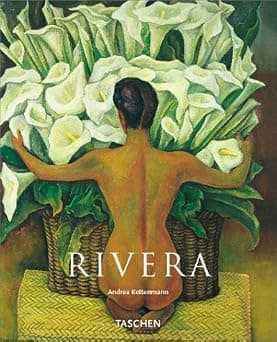 Further reading: Diego Rivera, 1886-1957: A Revolutionary Spirit in Modern Art (Taschen Basic Art) — Andrea Kettenmann
Palette
The colours reconstructed for this artist, with the reasoning behind each.
Pigments used: Ochre · Sienna · Ultramarine · Cobalt blue · Lime white · Cadmium yellow · Zinc white · Umber · Lamp black
Also in this era
Working at the same time
Elsewhere in the atlas, in other movements and other media, these were the hands at work during the same years.