Georgia O'Keeffe
1887–1986American · American Modernism 1910–1960
She painted flowers at the scale of billboards and spent the rest of her life denying they were about what everyone insisted they were about. She was probably telling the truth, and the insistence tells you a good deal about her audience.
Formation
Trained at the Art Institute of Chicago and the Art Students League, then taught in Texas and Virginia, where the flat landscape and the Arthur Wesley Dow method — composition as the arrangement of abstract shapes rather than the copying of nature — reorganised her thinking. Stieglitz exhibited her charcoals in 1916 without asking her, and later married her and photographed her extensively. She moved permanently to New Mexico after his death in 1946 and worked there until she was nearly a hundred.
Technique
Smooth, controlled and almost without evidence of the hand. O'Keeffe worked from careful preliminary drawings and applied oil in thin, even layers with soft blending and no impasto, producing a surface closer to airbrush or pastel than to gestural painting. The compositions are radically simplified and cropped — a flower is enlarged until the edges leave the canvas, a bone frames a hill through its own opening — and the simplification is Dow's method applied with complete conviction. She also worked extensively in watercolour early on and in pastel throughout.
The palette
Two distinct registers. The flowers use saturated, blended, closely graded colour — pinks, reds, deep purples, whites shading into greys — with transitions so smooth the form becomes ambiguous. The New Mexico work is the opposite: bleached bone white, red earth, hard blue sky, the colour of a specific place stated flatly. She was precise about local colour and painted what a landscape actually looks like at that altitude, which is why the pictures read as topographic and hallucinatory at once.
Legacy
She is the founding figure of American modernism as a distinct thing rather than a European derivative, and one of the very few women of her generation to achieve that standing in her lifetime. The persistent sexual reading of the flowers, which began with Stieglitz's own promotion of her, is a case study in how a woman artist's work gets interpreted for her, and her flat refusal of it across sixty years is part of the record.
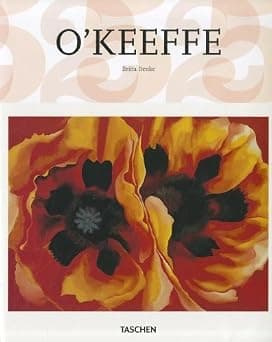 Further reading: O'Keeffe (Taschen Basic Art Series) — Britta Benke
Palette
The colours reconstructed for this artist, with the reasoning behind each.
Pigments used: Zinc white · Titanium white · Cadmium red · Ochre · Lead white · Cobalt blue · Cerulean blue · Umber · Alizarin crimson · Cadmium yellow · Sienna
Also in this era
Working at the same time
Elsewhere in the atlas, in other movements and other media, these were the hands at work during the same years.