Ernst Ludwig Kirchner
1880–1938German · Die Brücke & Der Blaue Reiter 1905–1925
He co-founded Die Brücke, painted Berlin street scenes that read as a diagnosis of the modern city, was declared degenerate by the Nazi regime, and shot himself in Switzerland in 1938.
Formation
Trained as an architect in Dresden, which gave him a structural sense but no painting instruction; he was essentially self-taught as a painter. In 1905 he and three fellow architecture students founded Die Brücke, a communal group that lived and worked together with an explicitly generational programme. They looked at Munch, at Van Gogh, at Fauve colour and at African and Oceanic carving in the Dresden ethnographic museum. He moved to Berlin in 1911, served briefly in the war, and had a physical and mental collapse in 1915 from which he never entirely recovered.
Technique
Fast, angular, and consciously crude. Kirchner used sharp, splintered brushstrokes and a hard-edged drawing style derived from woodcut — Die Brücke revived the woodblock print deliberately as a rough, German, anti-academic medium, and the cutting logic feeds back into the painting. He worked thinly and quickly on absorbent grounds, sometimes with paint diluted almost to a wash, leaving canvas visible. Figures are elongated, faces are mask-like, and perspective is tilted so that the Berlin street pictures pitch forward at the viewer.
The palette
Acid, dissonant and unnatural by design. Emerald and viridian against magenta, cadmium orange against ultramarine, pinks and sulphur yellows — combinations chosen because they clash. Skin is green, pink or orange. In the Berlin street scenes the artificial light of the pavement is rendered in acid greens and violets, which does for the electric city what Lautrec had begun with gaslight and pushes it into the realm of nightmare.
Legacy
Die Brücke is one of the two founding groups of German Expressionism, and the revived woodcut is among the most influential graphic developments of the century. Over six hundred of his works were confiscated from German museums in the 1937 Degenerate Art purge, and some were included in the exhibition itself; he killed himself the following year.
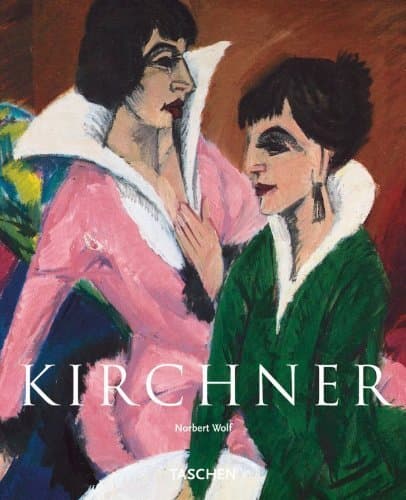 Further reading: Kirchner: On the Edge of the Abyss of Time (Taschen Basic Art) — Norbert Wolf
Palette
The colours reconstructed for this artist, with the reasoning behind each.
Pigments used: Emerald green · Viridian · Alizarin crimson · Cadmium red · Lead white · Ultramarine · Prussian blue · Chrome yellow · Cadmium yellow · Lamp black · Bone black · Ochre
Lexicon: Saturation / Chroma
Also in this era
Working at the same time
Elsewhere in the atlas, in other movements and other media, these were the hands at work during the same years.