Pollock
1912–1956American · Abstract Expressionism 1943–1965
He took the canvas off the easel, put it on the floor and walked around it, dripping and flinging paint from a stick. The four years that produced the drip paintings changed where the centre of gravity of Western art was located.
Formation
From Wyoming, trained under the regionalist Thomas Hart Benton in New York, who taught him composition through rhythm and the analysis of Old Master structure — an unlikely foundation that Pollock later credited. He encountered the Mexican muralists directly, working in Siqueiros's experimental workshop where industrial paint, spraying and pouring were being tested. He underwent Jungian analysis, which fed the mythic imagery of the 1940s, and was an alcoholic for most of his adult life. He died in a car crash in 1956 at forty-four.
Technique
The drip paintings, from 1947 to 1950, were made with the canvas unstretched on the studio floor, using hardened brushes, sticks and basting syringes to pour and fling liquid paint from above, moving continuously around and sometimes across the surface. There is no contact between tool and canvas. He described being "in" the painting, and the resulting line is a record of movement in time rather than a description of anything. Hans Namuth's photographs and film of him working were as influential as the paintings themselves. Analysis has since shown the layered skeins have a consistent statistical structure, which is one way of saying the control was real.
The palette
Commercial and industrial, not artists' colours. He used alkyd house paint — Duco and similar enamels — because it pours in a continuous unbroken line where oil paint breaks, and the choice is functional rather than symbolic. Aluminium paint for metallic threads, black, white, and strong secondary colours applied in layers so that the eye reads depth without any depicted space. The conservation consequences are serious: house paint of that period ages unpredictably, and several major works have suffered from cracking and yellowing.
Legacy
Abstract Expressionism moved the centre of the art world from Paris to New York, and Pollock is the figure through whom that shift is usually narrated. The drip technique made process itself the subject and opened directly onto performance, happenings and everything that treats making as the work. It also, less happily, produced the caricature of the artist as heroic drunk, which flattened the reception of everyone around him — particularly the women.
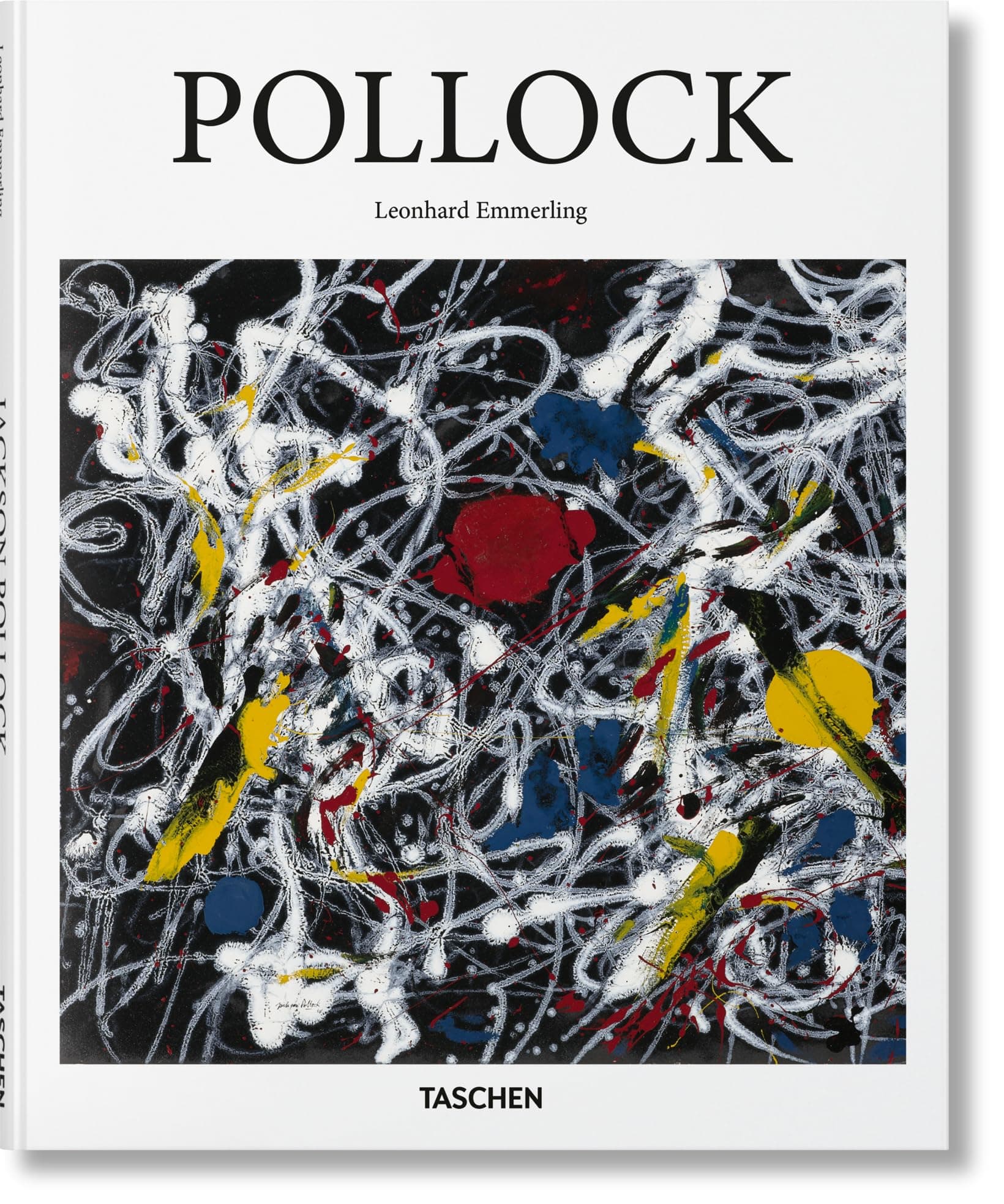 Further reading: Pollock (Basic Art) — Leonhard Emmerling
Palette
The colours reconstructed for this artist, with the reasoning behind each.
Also in this era
Working at the same time
Elsewhere in the atlas, in other movements and other media, these were the hands at work during the same years.